





Menu
Cognitive
Why We Judge Algorithmic Mistakes More Harshly Than Human Mistakes (via NPR)
March 1, 2015
In many areas, algorithms make fewer mistakes than humans. But new research suggests that we distrust algorithms when they make mistakes, in ways we do not distrust humans who make mistakes. This feels like a time - doesn't it? - when we might want to consider how much computers direct our lives. Computer programs, or algorithms, decide so much for us already. An algorithm is basically this set of instructions for a computer, kind of like the one in your thermostat. If the temperature falls below,...
March 1, 2015
In many areas, algorithms make fewer mistakes than humans. But new research suggests that we distrust algorithms when they make mistakes, in ways we do not distrust humans who make mistakes. This feels like a time - doesn't it? - when we might want to consider how much computers direct our lives. Computer programs, or algorithms, decide so much for us already. An algorithm is basically this set of instructions for a computer, kind of like the one in your thermostat. If the temperature falls below,...
A Feeling Of Fairness for Yourself and Others May Be Key to Acceptance
February 27, 2015
A key to resolving a dispute can be fairness. A plaintiff may accept a lower figure he or she originally had in mind and the defendant may offer more than originally intended, if the offer is deemed “fair.” Studies have shown that though we have similar opinions as to what is fair for ourselves or others, our brains determine that in very different ways. People will often turn down a sure reward if it’s the result from an unfair distribution of resources, according to studies. One study...
February 27, 2015
A key to resolving a dispute can be fairness. A plaintiff may accept a lower figure he or she originally had in mind and the defendant may offer more than originally intended, if the offer is deemed “fair.” Studies have shown that though we have similar opinions as to what is fair for ourselves or others, our brains determine that in very different ways. People will often turn down a sure reward if it’s the result from an unfair distribution of resources, according to studies. One study...
Are Your Clients Remembering That Story Accurately? Some Ways to Check
February 26, 2015
I recommend to you this excellent article written by the authors of The Invisible Gorilla: How Our Intuitions Deceive Us. They offer 10 ways to check the accuracy of our very malleable and faulty memory. Journalists know that when they hear something from one source, they should corroborate it with independent sources before reporting it. The science of memory has taught us that our own memories are also unreliable sources, just as needy of corroboration. Click to read the rest of "How Not to Be the Next...
February 26, 2015
I recommend to you this excellent article written by the authors of The Invisible Gorilla: How Our Intuitions Deceive Us. They offer 10 ways to check the accuracy of our very malleable and faulty memory. Journalists know that when they hear something from one source, they should corroborate it with independent sources before reporting it. The science of memory has taught us that our own memories are also unreliable sources, just as needy of corroboration. Click to read the rest of "How Not to Be the Next...
Risk Aversion and Real Life
February 24, 2015
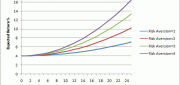
No doubt, you have read some interesting book or article and the next thing you know, it is playing out in real life. Well,...
February 24, 2015
No doubt, you have read some interesting book or article and the next thing you know, it is playing out in real life. Well,...
Did Hunger Sabotage A Mediation?
February 23, 2015
The other day, I conducted two mediations between the same plaintiff’s counsel, the same defendants and their counsel. The only different party in the two mediations was the plaintiff. One mediation was to start in the morning and the next in early afternoon, figuring each would take about 3 hours. Unfortunately, the first mediation lasted much longer than expected; about 5 ½ hours. Although it settled, it was a difficult settlement, and one that took a lot out of everyone to reach. I noticed...
February 23, 2015
The other day, I conducted two mediations between the same plaintiff’s counsel, the same defendants and their counsel. The only different party in the two mediations was the plaintiff. One mediation was to start in the morning and the next in early afternoon, figuring each would take about 3 hours. Unfortunately, the first mediation lasted much longer than expected; about 5 ½ hours. Although it settled, it was a difficult settlement, and one that took a lot out of everyone to reach. I noticed...
How Can You Make a Good First Impression?
February 20, 2015
The Science of First Impressions is a Lifehacker article by Jory MacKay and he brings up many good points, We are hard wired to make quick, not necessarily rational, decisions. When our ancestors lived on the plains of Africa, it was eat or be eaten. Being able to quickly size up situations and other people could be the difference between life and death. This “rapid cognition” is the ability to delve into the situation and decide what is most important very quickly. Psychologists call the ability...
February 20, 2015
The Science of First Impressions is a Lifehacker article by Jory MacKay and he brings up many good points, We are hard wired to make quick, not necessarily rational, decisions. When our ancestors lived on the plains of Africa, it was eat or be eaten. Being able to quickly size up situations and other people could be the difference between life and death. This “rapid cognition” is the ability to delve into the situation and decide what is most important very quickly. Psychologists call the ability...
Emotional Words Grab Attention, But May Not be Accurately Remembered
February 19, 2015
Using emotion when speaking may get a listener’s attention and make what you’re saying seem more compelling, but those short term gains have long term losses, according to research discussed in ScienceDigest. Emotion helps us recognize words faster and more accurately but in the long term emotionally intoned language is not as accurately remembered compared to neutral speech. When the words are remembered they have an emotional value. For instance words spoken in a sad voice are remembered...
February 19, 2015
Using emotion when speaking may get a listener’s attention and make what you’re saying seem more compelling, but those short term gains have long term losses, according to research discussed in ScienceDigest. Emotion helps us recognize words faster and more accurately but in the long term emotionally intoned language is not as accurately remembered compared to neutral speech. When the words are remembered they have an emotional value. For instance words spoken in a sad voice are remembered...
Keep Calm and Carry On May Not Always Be the Best Strategy
February 18, 2015
Negotiators are told to keep an even keel when in negotiations, don’t get too excited, down or angry. It should inspire confidence in your client and show the other party you’re in control. But burying that anger may not always help, according to a study discussed in Science Daily. Suppressing anger about important points can cause negotiators to lose focus on important issues, according to Bo Shao of the University of New South Wales in Australia. Though there is much information available...
February 18, 2015
Negotiators are told to keep an even keel when in negotiations, don’t get too excited, down or angry. It should inspire confidence in your client and show the other party you’re in control. But burying that anger may not always help, according to a study discussed in Science Daily. Suppressing anger about important points can cause negotiators to lose focus on important issues, according to Bo Shao of the University of New South Wales in Australia. Though there is much information available...
Time is “Like-the-Present”
February 17, 2015
There is an old adage, “Why do today what you can put off until tomorrow?” And indeed, many of us do just that because time is a precious commodity of which there is never enough. As a result, we address the issues or tasks that are the most pressing, figuring that we will get to the less pressing ones later when “there is more time.” (We have yet to accept the notion that there will never be enough time!) We are not alone in our thinking. A recent study discussed in the October 3, 2014...
February 17, 2015
There is an old adage, “Why do today what you can put off until tomorrow?” And indeed, many of us do just that because time is a precious commodity of which there is never enough. As a result, we address the issues or tasks that are the most pressing, figuring that we will get to the less pressing ones later when “there is more time.” (We have yet to accept the notion that there will never be enough time!) We are not alone in our thinking. A recent study discussed in the October 3, 2014...
What’s the Role of Playfulness in Creativity?
February 13, 2015
An important topic: play. Fortunately it is receiving serious attention these days. For example, Current Biology has devoted an edition to it. An excerpt from the article "Playfuness and creativity": Having fun is a good reason to be playful. The pleasure it generates could be seen as its primary benefit. Even so, I want to explore what can be the longer-term benefits of playfulness. For the biologist, benefits are measured in terms of the particular ways in which an activity increases the chances...
February 13, 2015
An important topic: play. Fortunately it is receiving serious attention these days. For example, Current Biology has devoted an edition to it. An excerpt from the article "Playfuness and creativity": Having fun is a good reason to be playful. The pleasure it generates could be seen as its primary benefit. Even so, I want to explore what can be the longer-term benefits of playfulness. For the biologist, benefits are measured in terms of the particular ways in which an activity increases the chances...


