





Risk Aversion and Real Life
This post has been viewed 3,355 times.
No doubt, you have read some interesting book or article and the next thing you know, it is playing out in real life. Well, this blog is about just that.
I am still trying to muddle through Thinking Fast and Slow by Daniel Kahneman (Farrar, Straus and Giroux, New York, 2011). As it is dense reading, requiring System 2 thought, it is taking me awhile. I am getting towards the end of the book in which Dr. Kahneman discusses prospect theory also known as decision making; why and how we make the decisions we make. (Id. at 300-309.) As he explains it,
…choices between gambles and sure things are resolved differently, depending on whether the outcomes are good or bad. Decision makers tend to prefer the sure thing over the gamble (they are risk averse) when the outcomes are good. They tend to reject the sure thing and accept the gamble (they are risk seeking) when both outcomes are negative.” (Id. at 368.)
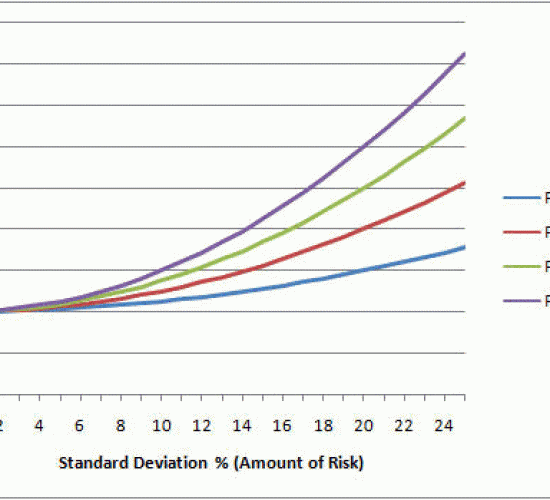
Thus, he addresses the well-known topic of “risk aversion”, or how people tend to avoid risk. As he puts it, “… losses loom larger than corresponding gains.” (Id. at pp. 297, 300.). Simply put, “Loss aversion refers to the relative strength of two motives: we are driven more strongly to avoid losses than to achieve gains.” (Id. at 302.)
Read original articleTags:


