


Menu
Data
3 Ways to Make Better Decisions — By Thinking Like a Computer
October 7, 2018
If you ever struggle to make decisions, here's a talk for you. Cognitive scientist Tom Griffiths shows how we can apply the logic of computers to untangle tricky human problems, sharing three practical strategies for making better decisions -- on everything from finding a home to choosing which restaurant to go to tonight.
How Gavelytics’ Judicial Analytics are Reshaping Litigation
October 6, 2018
What if a lawyer could know how a judge is likely to rule in a case or how heavy is a judge’s workload? Rick Merrill was a litigator at a large law firm who became frustrated over his inability to get meaningful information about the judges before whom he appeared. So last year, he launched Gavelytics, a California company that uses analytics and artificial intelligence to analyze docket data and provide lawyers with a range of insights about judges’ propensities, workloads and leanings. In...
Total Recall
October 3, 2018
Mediators need to remember stuff – lots of stuff. Sure, it helps to have a flush mentality – as my very first, and now long gone, boss used to tell me. Mr. Dalgety would come back to the office after a hearing, raise his hand beside his head and pull an imaginary chain before moving to his next case. Likewise for the duration of a mediation, especially on mediation day, successful mediators need to hold, and retrieve, large amounts of data. Our ability to take in information, store...

Walmart Uses IBM Blockchain to Track Spinach and Lettuce!
September 30, 2018
The New York Times reported that Walmart announced “After a two-year pilot project, …that it would be using a blockchain,...
September 30, 2018
The New York Times reported that Walmart announced “After a two-year pilot project, …that it would be using a blockchain,...
The Future of Jobs 2018
September 29, 2018
As technological breakthroughs rapidly shift the frontier between the work tasks performed by humans and those performed by machines and algorithms, global labour markets are likely to undergo major transformations. These transformations, if managed wisely, could lead to a new age of good work, good jobs and improved quality of life for all, but if managed poorly, pose the risk of widening skills gaps, greater inequality and broader polarization. In many ways, the time to shape the future of work...
Proposed Legislation Would Eliminate PACER Fees
September 29, 2018
A new bill before the U.S House of Representatives would prohibit the federal courts from charging for public documents. The Electronic Court Records Reform Act would require that documents downloaded from the PACER database be free. Currently, the repository for federal court documents charges up to 10 cents a page. “Americans deserve a justice system that is transparent and accessible,” said Republican Rep. Doug Collins of Georgia, the bill’s sponsor, in a statement on Sept. 6. “I...
The Politics of Selecting Chevron Deference
September 28, 2018
In this article, we examine an important threshold question in judicial behavior and administrative law: When do federal circuit courts decide to use the Chevron deference framework and when do they select a framework that is less deferential to the administrative agency's statutory interpretation? The question is important because the purpose of Chevron deference is to give agencies—not judges—policy‐making space within statutory interpretation. We expect, nonetheless, that whether to invoke...
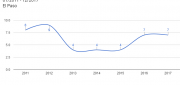
El Paso County Civil and Family Case Filings and Dispositions
September 25, 2018
Civil and family court filings in El Paso County have remained relatively stable during the seven full calendar year period...
September 25, 2018
Civil and family court filings in El Paso County have remained relatively stable during the seven full calendar year period...
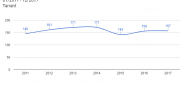
Tarrant County Civil and Family Case Filings and Dispositions
September 25, 2018
Civil and family court filings in Tarrant County have remained relatively stable during the seven full calendar year period...
September 25, 2018
Civil and family court filings in Tarrant County have remained relatively stable during the seven full calendar year period...
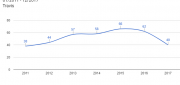
Travis County Civil and Family Case Filings and Dispositions
September 25, 2018
Civil and family court filings in Travis County have remained relatively stable during the seven full calendar year period...
September 25, 2018
Civil and family court filings in Travis County have remained relatively stable during the seven full calendar year period...