





Menu
ADR
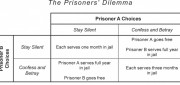
Legal Theory Lexicon: The Prisoners’ Dilemma
August 21, 2017
One of the most useful tools in analyzing legal rules and the policy problems to which they apply is game theory. The basic...
August 21, 2017
One of the most useful tools in analyzing legal rules and the policy problems to which they apply is game theory. The basic...
Elementary My Dear Watson!
August 19, 2017
In 2011, a computer gained fame as a celebrity. Its name was Watson*, of IBM. This was right after taking part in a very popular Q&A show on American TV (Jeopardy), in which Watson, with its ability to understand our language using only information recorded in its memory, and working offline, managed to successfully overcome two of the best Jeopardy players from past shows. Watson used Artificial Intelligence (AI) for this challenge. From there, AI has been increasingly discussed and applied...
Charkoudian, Eisenberg, & Walter on Outcomes of ADR versus Trial
August 14, 2017
Lorig Charkoudian, Deborah Thompson Eisenberg and Jamie Walter (Community Mediation Maryland, University of Maryland Francis King Carey School of Law and Maryland Judicial Center Administrative Office of the Courts) has posted What Difference Does ADR Make? Comparison of ADR and Trial Outcomes in Small Claims Court (34 Conflict Resolution Quarterly (2017)) on SSRN. Here is the abstract: This study compares the experience of small claims litigants who use alternative dispute resolution (“ADR”)...
Great Bibliography of Recent Empirical Research on ADR
August 10, 2017
Beginning in summer 2013, Donna Steinstra and I have co-edited Research Insights, a regular column in the American Bar Association’s Dispute Resolution Magazine (DRM). Twice a year we choose 10-12 empirical research studies relevant to ADR professionals and publish the citation and abstract. To compile the longer list from which we choose our subset for publication in the column, we’ve cast a fairly wide net looking for published research in a variety of fields, including social psychology,...
An Empirical Study of Litigants’ Awareness Of Court-Sponsored Alternative Dispute Resolution Programs
August 9, 2017
Professor Donna Shestowsky, University of California, Davis – School of Law, has written an interesting research paper titled, “When Ignorance is Not Bliss: An Empirical Study of Litigants’ Awareness Of Court-Sponsored Alternative Dispute Resolution Programs,” to be published in Volume 22 (Spring 2017) of the Harvard Negotiation Law Review; UC Davis Legal Studies Research Paper. In her article, Professor Shestowsky looks at whether individuals involved in state court litigation knew...
Dispute Resolution for Business and Transactional Lawyers Focus of BLN
July 28, 2017
Michael Zeytoonian echoed the need to make sure the clients choose the right process for their needs and their situational facts. He urged lawyers to conduct a process assessment with potential clients before they begin any course of action, focusing on client factors such as these: How quickly do they need the matter resolved? How importance is the relationship between the parties in the dispute? Is confidentiality important? Do they want to maintain control over the decision-making...
Living the Dream of ADR: Reflections on Four Decades of the Quiet Revolution in Dispute Resolution
July 28, 2017
This article, an expanded version of a symposium keynote address, examines the dramatic national and worldwide impact of the revolution in dispute resolution that was heralded by the 1976 Pound Conference. Professor Stipanowich explores (1) related changes in the justice system and legal practice; (2) the divergence in dispute resolution practice within and outside the U.S.; (3) the "gravitational pull" exerted by the legal profession on mediation and other processes; (4) concerns over racial, ethnic...

Why and How Businesses Use Planned Early Dispute Resolution
July 25, 2017
This article reports the results of an empirical inquiry analyzing why some businesses adopt “planned early dispute resolution”...
July 25, 2017
This article reports the results of an empirical inquiry analyzing why some businesses adopt “planned early dispute resolution”...

The Paradox of Access Justice, And Its Application to Mandatory Arbitration
July 21, 2017
Access justice is one of the most appealing and least contentious regulatory techniques in law’s repertoire. It aspires...
July 21, 2017
Access justice is one of the most appealing and least contentious regulatory techniques in law’s repertoire. It aspires...
Modria Joins Forces With Tyler Technologies
June 17, 2017
We are excited to share today that Modria, the world’s leading online dispute resolution (ODR) company, is being acquired by Tyler Technologies. Tyler is the largest software company in the world focused exclusively on local government. Tyler delivers all the essential software solutions that drive the public sector, empowering more than 15,000 local government offices across all 50 states in the U.S. with comprehensive software solutions. Modria will be joining Tyler’s Courts and Justice...


