





Menu
law firms
Law Firms’ Profit Expected to Grow by 5% in 2014, Report Predicts
January 15, 2014
There hasn’t been much to cheer about in the legal industry in recent years—at least not from the point of view of major law firms. But the 2014 outlook from Citi Private Bank and Hildebrandt Consulting, released on Monday, offers a little shaft of sunshine for beleaguered BigLaw after more than five years of slack demand, declining partnerproductivity and client pushback onpricing. Despite the difficulties, most major law firms have held on through the challenging years after the economic...
January 15, 2014
There hasn’t been much to cheer about in the legal industry in recent years—at least not from the point of view of major law firms. But the 2014 outlook from Citi Private Bank and Hildebrandt Consulting, released on Monday, offers a little shaft of sunshine for beleaguered BigLaw after more than five years of slack demand, declining partnerproductivity and client pushback onpricing. Despite the difficulties, most major law firms have held on through the challenging years after the economic...

Is the Law Firm Pyramid Collapsing? BigLaw is Aging With More Partners Than Associates
December 23, 2013
1988 was a peak year for associates in BigLaw. The percentage of associates in the nation’s top 250 law firms was at its highest...
December 23, 2013
1988 was a peak year for associates in BigLaw. The percentage of associates in the nation’s top 250 law firms was at its highest...
Decline in Female Associates Called a ‘Red Flag’
December 18, 2013
First the good news: The percentage of women and minority partners at law firms continued to inch up during 2013, according to the latest figures from the National Association for Law Placement. Now the bad: The percentage of women associates at law firms fell for the fourth straight year, even as the percentage of minority associates continued to rise. “Since the recession, we have seen the figures for women associates drop each of the four successive years,” NALP executive director James...
December 18, 2013
First the good news: The percentage of women and minority partners at law firms continued to inch up during 2013, according to the latest figures from the National Association for Law Placement. Now the bad: The percentage of women associates at law firms fell for the fourth straight year, even as the percentage of minority associates continued to rise. “Since the recession, we have seen the figures for women associates drop each of the four successive years,” NALP executive director James...
Is There a Future for Solos and Small Firms?
December 14, 2013
“I do not see much of a future (beyond 2020) for most small firms ….” — Richard Susskind, Tomorrow’s Lawyers Will the next 5–10 years really see the end of solos and small law firms? I’ve heard Susskind talk before, but today, I sat down with him at the William Mitchell College of Law to find out more about his predictions as they pertain to small law firms. The future according to Susskind Susskind’s most-recent book, Tomorrow’s Lawyers, is short and worth a read, but I will...
December 14, 2013
“I do not see much of a future (beyond 2020) for most small firms ….” — Richard Susskind, Tomorrow’s Lawyers Will the next 5–10 years really see the end of solos and small law firms? I’ve heard Susskind talk before, but today, I sat down with him at the William Mitchell College of Law to find out more about his predictions as they pertain to small law firms. The future according to Susskind Susskind’s most-recent book, Tomorrow’s Lawyers, is short and worth a read, but I will...
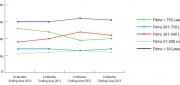
New Statistics Illustrate the Decline of BigLaw
November 23, 2013
Over the last three years the relative portion of legal work given to the largest, full-service law firms has declined from...
November 23, 2013
Over the last three years the relative portion of legal work given to the largest, full-service law firms has declined from...
In-House Counsel Get Real About Outside Firm Value
October 31, 2013
In a time of changing relationships between many in-house law departments and their outside counsel, there are legitimate motives for law firms to want to better understand how they can create value for their corporate clients. A panel discussion held in New York City on Thursday by the Legal Marketing Association’s Metropolitan New York Chapter, titled “Value—The Key Differentiator,” brought together three prominent in-house lawyers to talk about outside counsel value. All three...
October 31, 2013
In a time of changing relationships between many in-house law departments and their outside counsel, there are legitimate motives for law firms to want to better understand how they can create value for their corporate clients. A panel discussion held in New York City on Thursday by the Legal Marketing Association’s Metropolitan New York Chapter, titled “Value—The Key Differentiator,” brought together three prominent in-house lawyers to talk about outside counsel value. All three...
So, You Want to Go In-House?
October 8, 2013
Many law firm lawyers yearn to move in-house with a corporate law department, noting such benefits as abandoning the hassles of timesheets and eliminating the pressure to develop business. However, to successfully make this move, you must understand how the ideal in-house candidate profile differs from that for most law firms, and how best to present yourself as such a candidate in an interview. THE IDEAL CANDIDATE While lawyers at a firm typically specialize in a specific practice area, most in-house...
October 8, 2013
Many law firm lawyers yearn to move in-house with a corporate law department, noting such benefits as abandoning the hassles of timesheets and eliminating the pressure to develop business. However, to successfully make this move, you must understand how the ideal in-house candidate profile differs from that for most law firms, and how best to present yourself as such a candidate in an interview. THE IDEAL CANDIDATE While lawyers at a firm typically specialize in a specific practice area, most in-house...
To Cut Costs, Cut Associates’ Billable Hours Through Technology
September 21, 2013
D. Casey Flaherty deals mostly with Kia Motors America's outside law firms, and he often delivers this jolt: "I genuinely believe that partners' billing rates are too low." But the corporate counsel follows with this: " ... at least compared to billing rates for associates." Flaherty's concern is overspending on work assigned to associates, paralegals and others who bill time, not the high-priced partners whose experience and judgment he values. His unique approach is showing law firms they...
September 21, 2013
D. Casey Flaherty deals mostly with Kia Motors America's outside law firms, and he often delivers this jolt: "I genuinely believe that partners' billing rates are too low." But the corporate counsel follows with this: " ... at least compared to billing rates for associates." Flaherty's concern is overspending on work assigned to associates, paralegals and others who bill time, not the high-priced partners whose experience and judgment he values. His unique approach is showing law firms they...
Negotiation Strategies for Corporations and Law Firms
September 20, 2013
The TyMetrix Legal Analytics LegalVIEW® Forum brings law firms and corporations together to discuss the most pressing legal issues of the day and develop unique value-based best practices. OVERVIEW AT A GLANCE The Power of the New Normal Hear from industry veteran Tim Corcoran how adapting to the new normal is good for law firms, good for in-house counsel and good for business. The underlying point is that embracing these concepts aren't a necessary evil, but can actually lead to better...
September 20, 2013
The TyMetrix Legal Analytics LegalVIEW® Forum brings law firms and corporations together to discuss the most pressing legal issues of the day and develop unique value-based best practices. OVERVIEW AT A GLANCE The Power of the New Normal Hear from industry veteran Tim Corcoran how adapting to the new normal is good for law firms, good for in-house counsel and good for business. The underlying point is that embracing these concepts aren't a necessary evil, but can actually lead to better...
Lawyers’ Talks With Law Firm GC May Be Shielded
September 6, 2013
Communications between a law firm's attorneys and its in-house counsel regarding a client's potential malpractice claims against the firm may be protected by the attorney-client privilege, the Georgia Supreme Court ruled on Thursday. The unanimous decision, which sets several criteria for when the privilege shields talks with a firm's general counsel, is a win for law firms in that it rejected a position taken by several courts around the country—that a law firm doesn't enjoy attorney-client...
September 6, 2013
Communications between a law firm's attorneys and its in-house counsel regarding a client's potential malpractice claims against the firm may be protected by the attorney-client privilege, the Georgia Supreme Court ruled on Thursday. The unanimous decision, which sets several criteria for when the privilege shields talks with a firm's general counsel, is a win for law firms in that it rejected a position taken by several courts around the country—that a law firm doesn't enjoy attorney-client...


