





Menu
Cognitive
How to Know If You Talk Too Much
July 8, 2015
You may have heard the saying, “When you’re in love, smoke gets in your eyes.” Well when you’re talking, smoke gets in your eyes and ears. Once you’re on a roll, it’s very easy to not notice that you’ve worn out your welcome. You may not even realize that the other person is politely trying to get a word in, or subtly signaling that they need to be elsewhere (possibly, anywhere else if you have been really boring). There are three stages of speaking to other people. In the first...
July 8, 2015
You may have heard the saying, “When you’re in love, smoke gets in your eyes.” Well when you’re talking, smoke gets in your eyes and ears. Once you’re on a roll, it’s very easy to not notice that you’ve worn out your welcome. You may not even realize that the other person is politely trying to get a word in, or subtly signaling that they need to be elsewhere (possibly, anywhere else if you have been really boring). There are three stages of speaking to other people. In the first...
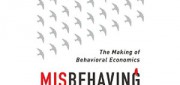
The Mischievous Science of Richard Thaler
July 7, 2015
Thaler has a mischievous mind. At the same time that he was producing his math-heavy dissertation, he started asking people...
July 7, 2015
Thaler has a mischievous mind. At the same time that he was producing his math-heavy dissertation, he started asking people...
Does the Endowment Effect Justify Legal Intervention? The Debiasing Effect of Institutions
July 6, 2015
We claim that the endowment effect rarely justifies legal intervention in private ordering. We present the first theory, to our knowledge, to explain how institutions inhibit the endowment effect without altering people’s rights to their entitlements. The endowment effect is substantially caused by anticipated regret. We show that people experience regret only when they feel responsible for the decision and can mute regret by trading through institutions that let them share responsibility with...
July 6, 2015
We claim that the endowment effect rarely justifies legal intervention in private ordering. We present the first theory, to our knowledge, to explain how institutions inhibit the endowment effect without altering people’s rights to their entitlements. The endowment effect is substantially caused by anticipated regret. We show that people experience regret only when they feel responsible for the decision and can mute regret by trading through institutions that let them share responsibility with...
If You Want People to Listen, Stop Talking
July 4, 2015
George*, a managing director at a large financial services firm, had an uncanny ability to move a roomful of people to his perspective. What George said was not always popular, but he was a master persuader. It wasn’t his title — he often swayed colleagues at the same hierarchical level. And it wasn’t their weakness — he worked with a highly competitive bunch. It wasn’t even his elegant and distinguished British accent — his British colleagues were persuaded right along with everyone...
July 4, 2015
George*, a managing director at a large financial services firm, had an uncanny ability to move a roomful of people to his perspective. What George said was not always popular, but he was a master persuader. It wasn’t his title — he often swayed colleagues at the same hierarchical level. And it wasn’t their weakness — he worked with a highly competitive bunch. It wasn’t even his elegant and distinguished British accent — his British colleagues were persuaded right along with everyone...
The Persuasiveness of a Chart Depends on the Reader, Not Just the Chart
July 3, 2015
“I’ll believe it when I see it,” is a hackneyed idiom, but it sticks because it happens to be mostly true. It’s one of the reasons why data visualization is emerging as a powerful information force in the crowded, intensely contested world of social media. It’s why, during last year’s State of the Union, the president live-tweeted charts to illustrate the points he was making in his speech. It’s why Ezra Klein publishes stories that deign to suggest they can explain something as vast...
July 3, 2015
“I’ll believe it when I see it,” is a hackneyed idiom, but it sticks because it happens to be mostly true. It’s one of the reasons why data visualization is emerging as a powerful information force in the crowded, intensely contested world of social media. It’s why, during last year’s State of the Union, the president live-tweeted charts to illustrate the points he was making in his speech. It’s why Ezra Klein publishes stories that deign to suggest they can explain something as vast...
Grexit Would Be Even More Dangerous than Economists Realize
July 3, 2015
After months of acrimonious negotiations, and despite a significant rapprochement between their position and their creditors’, the Greek coalition government has unexpectedly stopped negotiation discussions in their tracks, announcing a snap referendum for Sunday, July 5th, over the proposed deal with the EU. It’s a puzzling move. The Greek government’s own proposal to creditors had included 8 Billion Euros in extra measures — eight times the amount agreed to by the previous government...
July 3, 2015
After months of acrimonious negotiations, and despite a significant rapprochement between their position and their creditors’, the Greek coalition government has unexpectedly stopped negotiation discussions in their tracks, announcing a snap referendum for Sunday, July 5th, over the proposed deal with the EU. It’s a puzzling move. The Greek government’s own proposal to creditors had included 8 Billion Euros in extra measures — eight times the amount agreed to by the previous government...
Here’s How Managers Can Be Replaced by Software
July 3, 2015
iCEO illustrates another fact we need to face now: Corporate organizations are themselves a technology, one that has only existed in its current form for around 200 years, a fragment of human history. The corporate structure was created around the tools we had back in the 18th century to maximize scale while minimizing transaction costs. Now that structure is being disrupted by the advent of technologies which can accomplish many (if not most) of the projects we associate with corporations. With...
July 3, 2015
iCEO illustrates another fact we need to face now: Corporate organizations are themselves a technology, one that has only existed in its current form for around 200 years, a fragment of human history. The corporate structure was created around the tools we had back in the 18th century to maximize scale while minimizing transaction costs. Now that structure is being disrupted by the advent of technologies which can accomplish many (if not most) of the projects we associate with corporations. With...
How to Work with People Who Aren’t Good at Working with People
July 2, 2015
Although lower EQ people are generally less rewarding to deal with — they are grumpier, more negative, and more erratic than average — there will be many circumstances where we have to deal with low EQ individuals. Given the difficulties this can entail, it may be useful to keep in mind the following, evidence-based recommendations for managing those situations effectively: Be gentle. Be explicit. Be rational. Do not get offended. Finally, remember that just as high EQ is not always...
July 2, 2015
Although lower EQ people are generally less rewarding to deal with — they are grumpier, more negative, and more erratic than average — there will be many circumstances where we have to deal with low EQ individuals. Given the difficulties this can entail, it may be useful to keep in mind the following, evidence-based recommendations for managing those situations effectively: Be gentle. Be explicit. Be rational. Do not get offended. Finally, remember that just as high EQ is not always...
Competition to Cooperation
July 1, 2015
When I started mediating cases, I never thought that I would have to be aware of or learn advanced mathematics. But a book that I recently finished has shown me otherwise. Entitled, Rock, Paper, Scissors: Game Theory in Everyday Life, its author, Len Fisher, PhD. (Basic Books (2008)) explains how game theory applies to everyday life. In turn, game theory is predicated on the Nash equilibrium, named after John Nash who won a Nobel Prize in 1949 for discovering that all social dilemmas arise from the same...
July 1, 2015
When I started mediating cases, I never thought that I would have to be aware of or learn advanced mathematics. But a book that I recently finished has shown me otherwise. Entitled, Rock, Paper, Scissors: Game Theory in Everyday Life, its author, Len Fisher, PhD. (Basic Books (2008)) explains how game theory applies to everyday life. In turn, game theory is predicated on the Nash equilibrium, named after John Nash who won a Nobel Prize in 1949 for discovering that all social dilemmas arise from the same...
Mediation Games
June 30, 2015
John Nash died this week, in a tragic car accident. John Nash was the Nobel-prize winning mathematician whose theory of non-cooperative games published in 1950 has been described as one of the top ten ideas in economics in the 20th century. His theory introduced and explored the concept of what is known as Nash equilibrium. According to the New York Times obituary, Nash equilibrium provides a conceptually simple but powerful mathematical tool for analysing a wide range of competitive situations,...
June 30, 2015
John Nash died this week, in a tragic car accident. John Nash was the Nobel-prize winning mathematician whose theory of non-cooperative games published in 1950 has been described as one of the top ten ideas in economics in the 20th century. His theory introduced and explored the concept of what is known as Nash equilibrium. According to the New York Times obituary, Nash equilibrium provides a conceptually simple but powerful mathematical tool for analysing a wide range of competitive situations,...


