





Menu
Cognitive
Daniel Kahneman: A Short Course In Thinking About Thinking
August 26, 2015
Recently, I spent several months working closely with Danny Kahneman, the psychologist who is the co-creator of behavioral economics (with his late collaborator Amos Tversky), for which he won the Nobel Prize in Economics in 2002. My discussions with him inspired a 2-day "Master Class" given by Kahneman for a group of twenty leading American business/Internet/culture innovators—a microcosm of the recently dominant sector of American business—in Napa, California in July. They came to hear him lecture...
August 26, 2015
Recently, I spent several months working closely with Danny Kahneman, the psychologist who is the co-creator of behavioral economics (with his late collaborator Amos Tversky), for which he won the Nobel Prize in Economics in 2002. My discussions with him inspired a 2-day "Master Class" given by Kahneman for a group of twenty leading American business/Internet/culture innovators—a microcosm of the recently dominant sector of American business—in Napa, California in July. They came to hear him lecture...
Philip Tetlock: A Short Course in Superforecasting
August 25, 2015
On the weekend of July 30th, Edge convened one of its "Master Classes." In the past, these classes have featured short courses taught by people such as psychologist and Nobel Laureate Daniel Kahneman ("A Short Course in Thinking About Thinking"); behavioral economists Richard Thaler and Sendhil Mullainathan, again with Kahneman ("A Short Course in Behavioral Economics"); and genomic researchers George Church and J. Craig Venter ("A Short Course on Synthetic Genomics"). This year, the psychologist...
August 25, 2015
On the weekend of July 30th, Edge convened one of its "Master Classes." In the past, these classes have featured short courses taught by people such as psychologist and Nobel Laureate Daniel Kahneman ("A Short Course in Thinking About Thinking"); behavioral economists Richard Thaler and Sendhil Mullainathan, again with Kahneman ("A Short Course in Behavioral Economics"); and genomic researchers George Church and J. Craig Venter ("A Short Course on Synthetic Genomics"). This year, the psychologist...

The Research Is Clear: Long Hours Backfire for People and for Companies
August 24, 2015
So the bigger question we have to ask ourselves about overwork is not just, “Who’s to blame?” but a more basic one:...
August 24, 2015
So the bigger question we have to ask ourselves about overwork is not just, “Who’s to blame?” but a more basic one:...
Teaching Law and Neuroscience
August 16, 2015
We thank Adam for the opportunity to post here about our recently published coursebook, Law and Neuroscience. The book is published by Aspen and co-authored by Owen Jones (Vanderbilt), Jeffrey Schall (Vanderbilt), and Francis Shen (Univ. of Minnesota). The book has four main purposes: to introduce readers to how brain science is (and is not) already being used in a number of legal contexts; to provide a user-friendly foundation for understanding how the human brain works, and how new techniques...
August 16, 2015
We thank Adam for the opportunity to post here about our recently published coursebook, Law and Neuroscience. The book is published by Aspen and co-authored by Owen Jones (Vanderbilt), Jeffrey Schall (Vanderbilt), and Francis Shen (Univ. of Minnesota). The book has four main purposes: to introduce readers to how brain science is (and is not) already being used in a number of legal contexts; to provide a user-friendly foundation for understanding how the human brain works, and how new techniques...
5 Ways to Break Bad News Without Actually Lying
August 15, 2015
From these studies, it seems that there is no one best way to convey bad news, but these 5 principles should provide some guidance: Tell at least part of the truth if you think the person needs to hear it. Whether it’s a bad health prognosis or the need to let an employee you’re firing know how to avoid getting canned in the future, there are situations when you can provide help to the person receiving the negative message. Sugar coat it if you think the person can’t handle it (“it’s...
August 15, 2015
From these studies, it seems that there is no one best way to convey bad news, but these 5 principles should provide some guidance: Tell at least part of the truth if you think the person needs to hear it. Whether it’s a bad health prognosis or the need to let an employee you’re firing know how to avoid getting canned in the future, there are situations when you can provide help to the person receiving the negative message. Sugar coat it if you think the person can’t handle it (“it’s...
Feeling Like An Expert Has An Ironic Effect On Your Actual Knowledge
August 14, 2015
Think you’re an expert on biology, literature, philosophy or anything else? Read on… ‘Know-it-alls’ don’t know as much as they think, new research finds. The more people think they know about a topic, the more likely they are to claim that totally made-up facts are true, psychologists have found. In the study, 100 people were given a general knowledge quiz about personal finance. - See more at: http://www.spring.org.uk/2015/07/feeling-like-an-expert-has-an-ironic-effect-on-your-actual-knowledge.php#sthash.EWUKzmZT.dpuf
August 14, 2015
Think you’re an expert on biology, literature, philosophy or anything else? Read on… ‘Know-it-alls’ don’t know as much as they think, new research finds. The more people think they know about a topic, the more likely they are to claim that totally made-up facts are true, psychologists have found. In the study, 100 people were given a general knowledge quiz about personal finance. - See more at: http://www.spring.org.uk/2015/07/feeling-like-an-expert-has-an-ironic-effect-on-your-actual-knowledge.php#sthash.EWUKzmZT.dpuf
Damn Emotions!
August 14, 2015
Have you seen “Inside Out” yet? It’s the delightful Pixar movie portraying the conflicting emotions of an 11 year-old girl grappling with the difficulties of a move from Minnesota to San Francisco. Indeed, the emotions are characters themselves: Anger, Disgust, Fear, Sadness, and Joy. The film’s producers consulted psychologists who wrote a piece in the New York Times saying that people generally misunderstand emotions and that the movie generally characterized emotions pretty accurately. [E]motions...
August 14, 2015
Have you seen “Inside Out” yet? It’s the delightful Pixar movie portraying the conflicting emotions of an 11 year-old girl grappling with the difficulties of a move from Minnesota to San Francisco. Indeed, the emotions are characters themselves: Anger, Disgust, Fear, Sadness, and Joy. The film’s producers consulted psychologists who wrote a piece in the New York Times saying that people generally misunderstand emotions and that the movie generally characterized emotions pretty accurately. [E]motions...
How To Use Positive Framing to Persuade and Sell
August 13, 2015
You may not sell to chimps and bonobos, but a fascinating new experiment shows that our human preference for the positive is an evolved trait and deeply rooted in our psyche. Scientists at Yale and Duke set out to find if “positive framing” affected primates other than humans. Scientific American described the experiment: [The researchers} gathered 40 of our closest living relatives—23 chimpanzees and 17 bonobos—and offered them options for choosing food: either one or two fruits versus...
August 13, 2015
You may not sell to chimps and bonobos, but a fascinating new experiment shows that our human preference for the positive is an evolved trait and deeply rooted in our psyche. Scientists at Yale and Duke set out to find if “positive framing” affected primates other than humans. Scientific American described the experiment: [The researchers} gathered 40 of our closest living relatives—23 chimpanzees and 17 bonobos—and offered them options for choosing food: either one or two fruits versus...
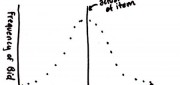
The Winner’s Curse
August 13, 2015
Sony recently won a “bidding war” (link is external) for an Emoji themed movie, after outbidding two other major studios....
August 13, 2015
Sony recently won a “bidding war” (link is external) for an Emoji themed movie, after outbidding two other major studios....
Smile at Party and People Are More Likely to Remember Seeing Your Face There
August 12, 2015
When you smile at a party, your facial expression is emotionally consistent with the happy context and as a consequence other guests will in future be more likely to remember that they've seen your face before, and where you were when they saw you. That's according to a team of Italian researchers led by Stefania Righi who have explored how memory for a face is affected by the emotion shown on that face and the congruence between that emotional expression and its surrounding context. The researchers...
August 12, 2015
When you smile at a party, your facial expression is emotionally consistent with the happy context and as a consequence other guests will in future be more likely to remember that they've seen your face before, and where you were when they saw you. That's according to a team of Italian researchers led by Stefania Righi who have explored how memory for a face is affected by the emotion shown on that face and the congruence between that emotional expression and its surrounding context. The researchers...


