How ‘Tomorrow’s Lawyers’ Are Using Technology Now to Improve Outcomes
This post has been viewed 4,099 times.
Remember the runaway bestseller Megatrends in 1983?
Author John Naisbitt captivated his audience by identifying 10 themes that would change the world. The relative accuracy of these predictions 30 years later is haunting.
Here they are:
1. Shift from an industrial society to an information society.
2. Shift from high-touch human responses to newly automated responses.
3. Shift from a national economy to a global economy.
4. Shift by management from short-term planning to long-term perspectives.
5. Rapid decentralization of business, politics, and culture.
6. Shift from institutional help to self-help.
7. Shift from a representational democracy to a participatory democracy.
8. Shift from hierarchies to networks.
9. Shift from Northeast to Southwest and Florida.
10. Shift from binary choices—that is, either/or—to multiple options.
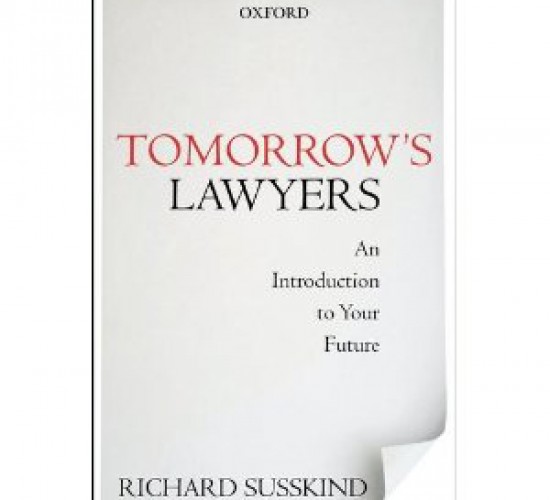
Richard Susskind is the John Naisbitt of legal megatrends. He’s shaken us up for years with The End of Lawyers? (2008), Transforming the Law (2000), and The Future of Law (1996). Like Naisbitt, he won’t be right on all of the particulars when we have the luxury of grading him 30 years down the road.
But some of his predictions are already upon us. Here are the three megatrends Susskind claims are combining to form a perfect storm in his latest book, Tomorrow’s Lawyers, which was published in March by Oxford University Press USA:
1. The “more-for-less” challenge from clients.
2. Liberalization of who can provide legal services and information.
3. Information technology.
Susskind is fascinated with big data and predictive analytics. According to Google Executive Chairman Eric Schmidt, we create more information every two days than we did from the dawn of civilization through 2003.
Cheap storage has made retention of that data possible. With it, Google can predict flu trends faster than the CDC based on user’s searches for flu-related topics. President Obama last month issued an Executive Order noting that government weather data in the hands of entrepreneurs had created GPS technology, and requiring that the “default state of…Government information resources shall be open and machine readable.” Executive Order, “Making Open and Machine Readable the New Default for Government Information” (May 9, 2013)(available at 1.usa.gov/193lKN6).
“Apollo 11 ran on approximately 74 kilobytes of memory and did 50 calculations per second,” noted Ian Koenig of LexisNexis in a recent ABA Journal piece. Joe Dysart, “How lawyers are mining the information mother lode for pricing, practice tips and predictions,” ABA Journal (May 2013)(available at bit.ly/ZMwHmy). LexisNexis’ system, Koenig adds in the article, now crunches between 5,000 and 10,000 calculations per second.
And these technologies are increasingly available to lawyers. Stanford Law’s Mark Lemley believes “analytics is the wave of the future.” Id. LexMachina’s computers already crawl the entire federal court PACER docketing system daily looking for patent documents so practitioners can determine whether to try or settle their IP case. Lexis Advance MedMal Navigator offers similar predictions in medical malpractice cases. Id. A recent article in the
Journal of Empirical Legal Studies described a predictive system that uses company share prices to help value securities class actions. The aforementioned TyMetrix draws on the billions of dollars in legal bills it has collected with permission through its sister bill review product to help project how much a matter will cost.
SkyAnalytics, of Andover, Mass., offers a macro view into the costs of legal services; Serengeti Law, a Thomson Reuters legal matters management unit based in Bellevue, Wash., offers a similar product. Not only are general counsel using the predictive power of such analytics to form budgets and choose outside counsel, law firms are using the data and analytics to gauge case strength and to get a read on what other firms are charging. Id. “The ability to learn in real time and gain insights from meaningful, predictive data is increasingly important to delivering new levels of value to clients,” said Bill Turner, chief knowledge officer of Womble Carlyle Sandridge & Rice in Winston-Salem, N.C., in the ABA Journal article.
And this author’s Picture It Settled® is Moneyball for negotiation. The behavioral software has learned negotiating patterns from parties to thousands of litigated cases in a wide variety of jurisdictions and claim types.
Picture It Settled® recently predicted the outcome of an IP dispute within 3.5% after just two rounds—and those predictions improved with additional offer data (17 total rounds). These projections look like “hurricane tracks” coming from each side to form a zone of potential agreement in the overlapping areas.
The predictions become actionable intelligence when parties calibrate their concession plans by dragging the target settlement dot to an advantageous, but probable, outcome. Using splines informed by settlement data, parties can then work toward settlement by making offers intended to induce cooperative reciprocation.
By constantly inputting offer data and updating realistic targets in the game-like interface, users are able to increase their settlement rates by using a data-informed negotiation strategy. Picture It Settled® doesn’t replace honed intuition; it puts a scope on the human controlled gun.
* * *
These are exciting times for legal technology.
Increased computing power, cheap data storage, and rapid and ubiquitous communications have opened up new frontiers. Firms are mining their historical data and new data sets are being collected to aid decision-makers. Human judgment aided by advanced analytics is a powerful combination
Read original articleTags: ABA Journal, John Naisbitt, predictions, Richard Susskind
Related Posts