





Litigation Risk Assessment: A Tool to Enhance Negotiation
This post has been viewed 4,946 times.
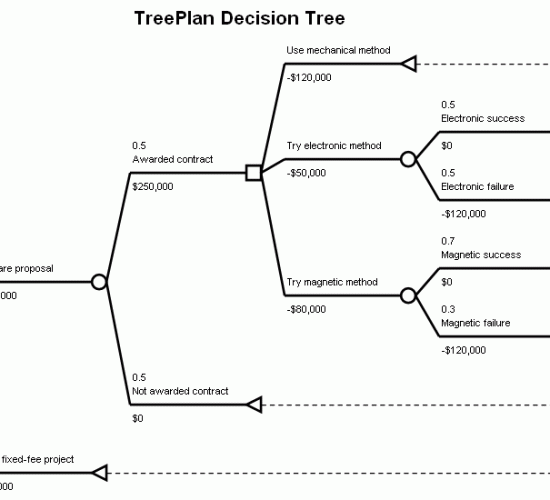
Comparisons between final settlement offers and trial outcomes raise serious questions about whether lawyers and clients are making good decisions in the litigation process. Litigation involves the exercise of judgment in complex situations with multiple uncertainties, where common psychological decision-making biases are sure to have influence. Without clear projections about where the path of litigation is most likely to lead, clients can be anchored in unrealistic expectations about the outcome and the costs of getting there. Fundamental to the lawyer’s ethical role is the obligation to provide transparent information about legal rights and risks,’ and fundamental to settlement processes is the presumption of informed decision-making. Rising public policy concerns about the accessibility of justice also bring the litigation process under greater scrutiny. A growing environment of accountability reinforces the lawyer’s obligation to provide open, transparent, and precise advice to clients about the legal processes in which they may find themselves.
This paper begins with a discussion of how “good” and “bad” predictions about litigation risk can affect a negotiation process. It explores how thorough predictions are often missing in the way that lawyers and clients prepare for, and navigate through, their negotiations. Drawing on a recent study of lawyers and law students, this paper summarizes a simple framework for conducting a thorough risk assessment, and then examines the way that it can be used to support the pursuit of settlement. Two conclusions emerge from the study, and in particular from the observation of how law students negotiated a hypothetical civil litigation file. A risk analysis can ground the negotiator and client with a well-prepared reference point (or BATNA, discussed further below) and help identify the bargaining zone, adding strength to decision-making. Further, it can reduce adversarial posturing and even build trust and transparency in negotiation, assisting in the construction of a problem-solving process. This paper seeks to contribute to the development of best practices around the use of risk analysis, and the quest for more responsive and earlier settlement outcomes for clients.
Read original articleTags:


