





Improving End-to-End Models For Speech Recognition
This post has been viewed 3,601 times.
Traditional automatic speech recognition (ASR) systems, used for a variety of voice search applications at Google, are comprised of an acoustic model (AM), a pronunciation model (PM) and a language model (LM), all of which are independently trained, and often manually designed, on different datasets [1]. AMs take acoustic features and predict a set of subword units, typically context-dependent or context-independent phonemes. Next, a hand-designed lexicon (the PM) maps a sequence of phonemes produced by the acoustic model to words. Finally, the LM assigns probabilities to word sequences. Training independent components creates added complexities and is suboptimal compared to training all components jointly. Over the last several years, there has been a growing popularity in developing end-to-end systems, which attempt to learn these separate components jointly as a single system. While these end-to-end models have shown promising results in the literature [2, 3], it is not yet clear if such approaches can improve on current state-of-the-art conventional systems.
Today we are excited to share “State-of-the-art Speech Recognition With Sequence-to-Sequence Models [4],” which describes a new end-to-end model that surpasses the performance of a conventional production system [1]. We show that our end-to-end system achieves a word error rate(WER) of 5.6%, which corresponds to a 16% relative improvement over a strong conventional system which achieves a 6.7% WER. Additionally, the end-to-end model used to output the initial word hypothesis, before any hypothesis rescoring, is 18 times smaller than the conventional model, as it contains no separate LM and PM.
Our system builds on the Listen-Attend-Spell (LAS) end-to-end architecture, first presented in [2]. The LAS architecture consists of 3 components. The listener encoder component, which is similar to a standard AM, takes the a time-frequency representation of the input speech signal, x, and uses a set of neural network layers to map the input to a higher-level feature representation, henc. The output of the encoder is passed to an attender, which uses henc to learn an alignment between input features x and predicted subword units {yn, … y0}, where each subword is typically a graphemeor wordpiece. Finally, the output of the attention module is passed to the speller (i.e., decoder), similar to an LM, that produces a probability distribution over a set of hypothesized words.
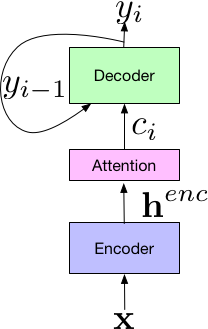 |
| Components of the LAS End-to-End Model. |
Tags:


