





Biologists Find New Rules for Life at the Edge of Chaos
This post has been viewed 2,782 times.
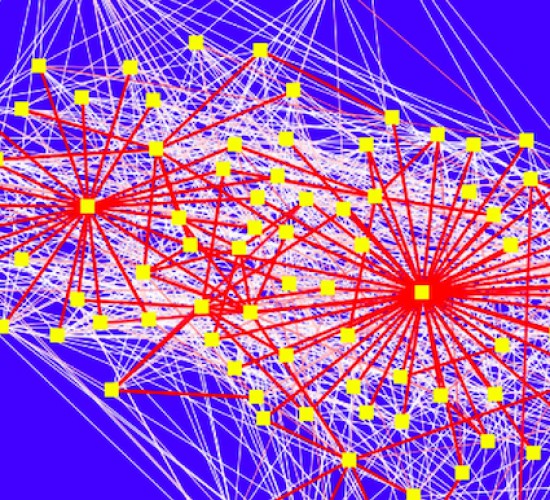
In the space between order and chaos, a zone usually described with the mathematics of impending avalanches and crystallizing liquids, scientists are finding new rules for life.
They’re researching the dynamics of criticality, where one system transforms rapidly into another. Scientists have studied such behavior in physical systems for decades; some have theorized that it might be found in living systems too, perhaps underlying some of biology’s fundamental and largely unexplained phenomena: how a few interacting genes shape an organism’s development, and how networked neurons give rise to complex cognitive functions.
Such speculation has been intriguing, but also difficult to study. Only now, with the advent of exquisitely sensitive biological probes and high-powered data analysis, have experiments started catching up to theory.
“In the past, there has been a lot of discussion about the potential benefits of biological systems poised at criticality,” said theoretical biophysicist Dmitry Krotov of Princeton University, co-author of a Feb. 10 Proceedings of the National Academy of Sciences paper on criticality in genetic networks. “Now high-quality experimental data are appearing, and we are able to quantitatively test these ideas.”
In the new study, Krotov and co-author William Bialek, also a biophysicist at Princeton, measured protein-coding activity in a genetic network crucial to the development of fruit fly embryos. Expressed in mathematical terms, the activity contained the signatures — relationships between gene activity, patterns of correlation at far-flung locations in embryos — characteristic of criticality.
Read original articleTags: criticality, Dmitry Krotov


