





Menu
Predictive Analytics
Artificial Intelligence is Here
January 13, 2016
As IBM’s Rob High discussed in a recent ABJ article, leadership in artificial intelligence has been a reality for years. Most people are familiar with IBM’s focus on cognitive computing through Watson, the “Jeopardy” winning natural language processor that has a major presence in Austin. In addition to my company, SparkCognition, organizations such as Umbel, Lucid, WayBlazer, and CognitiveScale are advancing machine learning in their respective verticals. Whether it is energy, security, health...
January 13, 2016
As IBM’s Rob High discussed in a recent ABJ article, leadership in artificial intelligence has been a reality for years. Most people are familiar with IBM’s focus on cognitive computing through Watson, the “Jeopardy” winning natural language processor that has a major presence in Austin. In addition to my company, SparkCognition, organizations such as Umbel, Lucid, WayBlazer, and CognitiveScale are advancing machine learning in their respective verticals. Whether it is energy, security, health...
Patent Litigation Up in 2015, Despite Efforts to Rein it In
January 11, 2016
Patent litigation brought by so-called “non-practicing entities” continued to flourish in 2015, according to a new study, despite repeated attempts to curtail it. According to the report, released Monday by RPX Corp., NPEs filed over 3,600 patent cases in 2015. NPEs, also referred to derisively by some as “patent trolls,” buy up patents and seek to make money from them through licensing and litigation. NPEs filed 3,604 cases last year, a sharp increase over 2014, in which NPEs filed...
January 11, 2016
Patent litigation brought by so-called “non-practicing entities” continued to flourish in 2015, according to a new study, despite repeated attempts to curtail it. According to the report, released Monday by RPX Corp., NPEs filed over 3,600 patent cases in 2015. NPEs, also referred to derisively by some as “patent trolls,” buy up patents and seek to make money from them through licensing and litigation. NPEs filed 3,604 cases last year, a sharp increase over 2014, in which NPEs filed...
Lawyers Need to Embrace Business Intelligence (BI)
January 7, 2016
A recent IBM eBook points how that “in today’s competitive global marketplace, leading organizations are complementing their current approaches to business intelligence (BI) and analytics.” IBM’s eBook is entitled “Forward Looking Business Intelligence” and given the scope and volume of Electronically Stored Information (ESI) in litigation today the use of BI seems pretty logical given IBM’s three principal types of analytics: Descriptive, which uses BI and data mining to answer...
January 7, 2016
A recent IBM eBook points how that “in today’s competitive global marketplace, leading organizations are complementing their current approaches to business intelligence (BI) and analytics.” IBM’s eBook is entitled “Forward Looking Business Intelligence” and given the scope and volume of Electronically Stored Information (ESI) in litigation today the use of BI seems pretty logical given IBM’s three principal types of analytics: Descriptive, which uses BI and data mining to answer...

Can Lawyers Get Smarter by Using Artificial Intelligence (AI)?
January 5, 2016
Since I first learned about AI more than 40 years ago I was hoping that AI would help improve society, and when in studying...
January 5, 2016
Since I first learned about AI more than 40 years ago I was hoping that AI would help improve society, and when in studying...
The 10 Most Important Legal Technology Developments of 2015
January 3, 2016
What have been 2015’s most important developments in legal technology? For the past two years, I’ve posted my picks of the top developments in legal tech (2014, 2013). With another year under our belts, it’s time to look back at 2015. 1. Case Law Gets Democratized. 2. Analytics Take Center Stage. The second-biggest legal technology story of 2015 was the acquisition of Lex Machina by LexisNexis. It was a significant deal in itself, but even more so for what it signals about the direction...
January 3, 2016
What have been 2015’s most important developments in legal technology? For the past two years, I’ve posted my picks of the top developments in legal tech (2014, 2013). With another year under our belts, it’s time to look back at 2015. 1. Case Law Gets Democratized. 2. Analytics Take Center Stage. The second-biggest legal technology story of 2015 was the acquisition of Lex Machina by LexisNexis. It was a significant deal in itself, but even more so for what it signals about the direction...
Artificial Intelligence in a Legal Environment
December 26, 2015
Industry publications and blogs make it sound like just a matter of time before all attorneys are replaced by robots or software programs, and artificial intelligence will run practices, handle cases and argue the law in front of juries. Consider IBM’s Watson. According to IBM, Watson is “a technology platform that uses natural language processing and machine learning to reveal insights from large amounts of unstructured data.” Feasibility Index: 1 out of 5 Realistically, robots won’t...
December 26, 2015
Industry publications and blogs make it sound like just a matter of time before all attorneys are replaced by robots or software programs, and artificial intelligence will run practices, handle cases and argue the law in front of juries. Consider IBM’s Watson. According to IBM, Watson is “a technology platform that uses natural language processing and machine learning to reveal insights from large amounts of unstructured data.” Feasibility Index: 1 out of 5 Realistically, robots won’t...
4 Legal Tech Trends To Watch For In 2016
December 25, 2015
As 2015 comes to a close, it’s only natural to peek ahead to see what’s in store for 2016. As a whole, legal technology is still just a baby of an industry which pales in comparison to the technology revolution going on in the financial industry. It remains an open question whether legal-tech startups will be attractive targets for early stage venture capital companies. But 2015 began to show some serious promise with some of the biggest Silicon Valley VCs placing bets on legal tech. If you want...
December 25, 2015
As 2015 comes to a close, it’s only natural to peek ahead to see what’s in store for 2016. As a whole, legal technology is still just a baby of an industry which pales in comparison to the technology revolution going on in the financial industry. It remains an open question whether legal-tech startups will be attractive targets for early stage venture capital companies. But 2015 began to show some serious promise with some of the biggest Silicon Valley VCs placing bets on legal tech. If you want...
How Many of Your Daily Tasks Could Be Automated?
December 22, 2015
A sea of ink and hours of video have been dedicated to the looming battle between humans and machines, often concluding that the machines win and human workers lose. It is a nearly irresistible narrative, which has been captured in books such as Martin Ford’s Rise of the Robots and The Second Machine Age, by Erik Brynjolfsson and Andrew McAfee. It has also has inspired scholarship by academics such as Carl Benedikt Frey and Michael Osborne of Oxford University, who estimate that 47% of occupations...
December 22, 2015
A sea of ink and hours of video have been dedicated to the looming battle between humans and machines, often concluding that the machines win and human workers lose. It is a nearly irresistible narrative, which has been captured in books such as Martin Ford’s Rise of the Robots and The Second Machine Age, by Erik Brynjolfsson and Andrew McAfee. It has also has inspired scholarship by academics such as Carl Benedikt Frey and Michael Osborne of Oxford University, who estimate that 47% of occupations...
Robots Aren’t Going to Replace Us, But Enhance Us
December 22, 2015
This is the coming world of augmented humans, where technology gifts people senses, skills, and strengths never before available. The swallowable robot is only one scenario that researchers in Bristol in the west of England are working to make a reality, as part of research that seeks to use bots to enhance, rather than replace, people. Other projects include work to allow surgeons to operate on people located miles away with superhuman precision, and managers to split their day between offices...
December 22, 2015
This is the coming world of augmented humans, where technology gifts people senses, skills, and strengths never before available. The swallowable robot is only one scenario that researchers in Bristol in the west of England are working to make a reality, as part of research that seeks to use bots to enhance, rather than replace, people. Other projects include work to allow surgeons to operate on people located miles away with superhuman precision, and managers to split their day between offices...
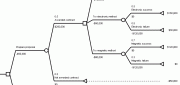
Advantages of Risk Analysis in Litigation
December 22, 2015
An indispensable tool for arriving at an informed settlement position Enhances counsel’s professional judgment “Gut...
December 22, 2015
An indispensable tool for arriving at an informed settlement position Enhances counsel’s professional judgment “Gut...


