





Menu
Predictive Analytics

Legaltech New York 2016 And My Invisibility Cloak
March 12, 2016
Last week I made my annual pilgrimage to Legaltech New York. This conference is hands down one of my favorite legal technology...
March 12, 2016
Last week I made my annual pilgrimage to Legaltech New York. This conference is hands down one of my favorite legal technology...
Harvard Law Prof Says Technology Will Replace Some Lawyers – How Many
March 12, 2016
HLS Professor David Wilkins, Director of Harvard's Center for the Legal Profession, which studies the impact of globalization on the delivery of legal services, says that technology will "of course" replace the need to hire some lawyers. The only question is how large the impact will be. His remarks are included in an article entitled The Laws of Adaptation published in the fall edition of the Harvard Law Bulletin. Here's an excerpt: The warning bells have been ringing for at least two decades:...
March 12, 2016
HLS Professor David Wilkins, Director of Harvard's Center for the Legal Profession, which studies the impact of globalization on the delivery of legal services, says that technology will "of course" replace the need to hire some lawyers. The only question is how large the impact will be. His remarks are included in an article entitled The Laws of Adaptation published in the fall edition of the Harvard Law Bulletin. Here's an excerpt: The warning bells have been ringing for at least two decades:...
On Artificial Intelligence and Contract Law
March 11, 2016
Ian Kerr of the University of Ottawa's Centre for Law, Technology and society has an interesting post from last September on a topic of that has been of occasional discussion on this blog, and which I came across only recently. In "The Arrival of Artificial Intelligence and 'The Death of Contract,'" Kerr outlines some of the foreseeable challenges facing today's students of contract law due to disruptive technology: On the market today are a number of AI products that carry out contract review and analysis....
March 11, 2016
Ian Kerr of the University of Ottawa's Centre for Law, Technology and society has an interesting post from last September on a topic of that has been of occasional discussion on this blog, and which I came across only recently. In "The Arrival of Artificial Intelligence and 'The Death of Contract,'" Kerr outlines some of the foreseeable challenges facing today's students of contract law due to disruptive technology: On the market today are a number of AI products that carry out contract review and analysis....
Experts, Crowds & Algorithms: The Three Forms of (Legal) Prediction
March 6, 2016
About the talk: Lawyer’s obligations of competence will increasingly encompass the ability to meaningfully apply analytics...
March 6, 2016
About the talk: Lawyer’s obligations of competence will increasingly encompass the ability to meaningfully apply analytics...
Four Behaviors are the Most Reliable Predictors of Divorce
March 6, 2016
When the psychologists added questions about things like relationship satisfaction and how many times the research subjects had thoughts about separating to the mix, they could predict which marriages would end in divorce 93% of the time. The figure, which comes from a 14-year study of 79 couples living across the US Midwest (21 of whom divorced during the study period), was so striking it spurned the researchers to label the four behaviors "the four horsemen of the apocalypse."
March 6, 2016
When the psychologists added questions about things like relationship satisfaction and how many times the research subjects had thoughts about separating to the mix, they could predict which marriages would end in divorce 93% of the time. The figure, which comes from a 14-year study of 79 couples living across the US Midwest (21 of whom divorced during the study period), was so striking it spurned the researchers to label the four behaviors "the four horsemen of the apocalypse."

Salesforce Acquires Machine Learning Startup PredictionIO
March 5, 2016
Salesforce has acquired PredictionIO, a startup with general-purpose open source machine learning software, Simon Chan, the startup’s...
March 5, 2016
Salesforce has acquired PredictionIO, a startup with general-purpose open source machine learning software, Simon Chan, the startup’s...
Data Mining Reveals How Smiling Evolved During a Century of Yearbook Photos
March 5, 2016
Data mining has changed the way we think about information. Machine-learning algorithms now routinely chomp their way through data sets of Twitter conversations, travel patterns, phone calls, and health records, to name just a few. And the insights this brings is dramatically improving our understanding of communication, travel, health, and so on. But there is another historical data set that has been largely ignored by the data-mining community—photographs. This presents a more complex challenge. For...
March 5, 2016
Data mining has changed the way we think about information. Machine-learning algorithms now routinely chomp their way through data sets of Twitter conversations, travel patterns, phone calls, and health records, to name just a few. And the insights this brings is dramatically improving our understanding of communication, travel, health, and so on. But there is another historical data set that has been largely ignored by the data-mining community—photographs. This presents a more complex challenge. For...
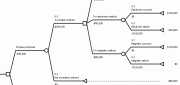
Advance Sheet: Risk Assessment
March 2, 2016
Risk numbers do have some value, however, in calculating settlement figures. As a defendant you can always take the maximum...
March 2, 2016
Risk numbers do have some value, however, in calculating settlement figures. As a defendant you can always take the maximum...
Using a Bot to Fight a Parking Ticket?
March 1, 2016
An enterprising Stanford student thinks he can get you out of a parking ticket without the cost of a lawyer. So how does it work? Users engage with chat screen where the “robot lawyer” asks questions such as, "Were you the one driving?" and, "Was it hard to understand the parking signs?" After the Q&A, the bot generates an appeal letter which the user sends to the court. The service comes at no cost. * * * Browder’s bot and Fixed are among several legal bots popping up in the market...
March 1, 2016
An enterprising Stanford student thinks he can get you out of a parking ticket without the cost of a lawyer. So how does it work? Users engage with chat screen where the “robot lawyer” asks questions such as, "Were you the one driving?" and, "Was it hard to understand the parking signs?" After the Q&A, the bot generates an appeal letter which the user sends to the court. The service comes at no cost. * * * Browder’s bot and Fixed are among several legal bots popping up in the market...
Artificial Intelligence and Law Practice Conference at Vanderbilt
March 1, 2016
The conference, called Watson, Esq. Will Your Next Lawyer Be a Machine will be held at Vanderbilt Law School on April 13 and 14, 2016 and features several notable speakers on legal practice futurism and technology including Richard Susskind, author of The End of Lawyers? Rethinking the Nature of Legal Services, and Andrew Arruda, whose firm ROSS Intelligence helped build ROSS, the world’s first artificially intelligent attorney, on top of IBM's Watson. Go here to see the full list of speakers...
March 1, 2016
The conference, called Watson, Esq. Will Your Next Lawyer Be a Machine will be held at Vanderbilt Law School on April 13 and 14, 2016 and features several notable speakers on legal practice futurism and technology including Richard Susskind, author of The End of Lawyers? Rethinking the Nature of Legal Services, and Andrew Arruda, whose firm ROSS Intelligence helped build ROSS, the world’s first artificially intelligent attorney, on top of IBM's Watson. Go here to see the full list of speakers...


