





Why Most of Us Fail to Grasp Coming Exponential Gains in AI
This post has been viewed 3,914 times.
By now, most of us are familiar with Moore’s Law, the famous maxim that the development of computing power follows an exponential curve, doubling in price-performance (that is, speed per unit cost) every 18 months or so. When it comes to applying Moore’s Law to their own business strategies, however, even visionary thinkers frequently suffer from a giant “AI blind spot.”
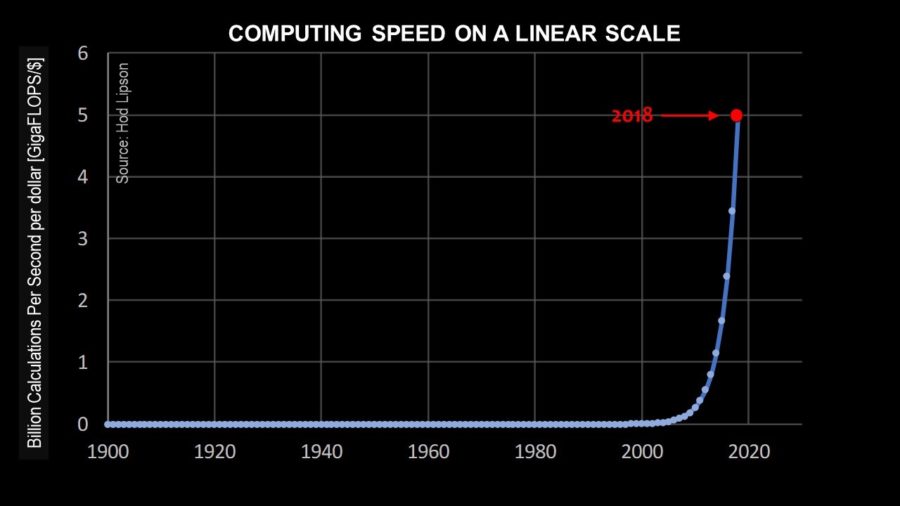
As Moore’s Law continues to make itself felt, it’s tempting to think at this very moment we’re reaching a unique period of great change in the development of artificial intelligence (or any other technology that rides on Moore’s Law). However, as long as processing power continues to follow an exponential price-performance curve, each future generation will likely look back on the past as an era of relatively little progress. In turn, the converse will also remain true: each current generation will look 10 years into its future and fail to appreciate just how much advancement in artificial intelligence is yet to come.
The challenge, then, for anyone planning for a future driven by computing’s exponential growth is fighting their brain’s flawed interpretations. Hard as it may sound, you need to hold all three charts in your mind at once—the visual consistency of the logarithmic chart and the drama but deceptive scale of the linear charts—to truly appreciate the power of exponential growth. Because the past will always look flat, and the future will always look vertical.
Tags:


