





Tacotron 2: Generating Human-like Speech from Text
This post has been viewed 4,761 times.
Generating very natural sounding speech from text (text-to-speech, TTS) has been a research goal for decades. There has been great progress in TTS research over the last few years and many individual pieces of a complete TTS system have greatly improved. Incorporating ideas from past work such as Tacotron and WaveNet, we added more improvements to end up with our new system, Tacotron 2. Our approach does not use complex linguistic and acoustic features as input. Instead, we generate human-like speech from text using neural networks trained using only speech examples and corresponding text transcripts.
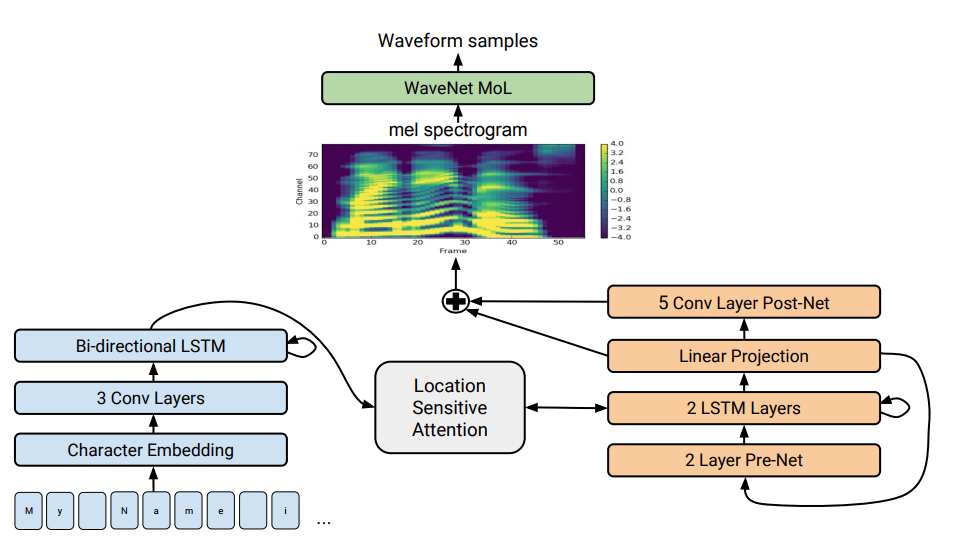
A full description of our new system can be found in our paper “Natural TTS Synthesis by Conditioning WaveNet on Mel Spectrogram Predictions.” In a nutshell it works like this: We use a sequence-to-sequence model optimized for TTS to map a sequence of letters to a sequence of features that encode the audio. These features, an 80-dimensional audio spectrogram with frames computed every 12.5 milliseconds, capture not only pronunciation of words, but also various subtleties of human speech, including volume, speed and intonation. Finally these features are converted to a 24 kHz waveform using a WaveNet-like architecture.
 |
Tags:


