





The 280-Year-Old Algorithm Inside Google Trips
This post has been viewed 2,954 times.
Algorithms Engineering is a lot of fun because algorithms do not go out of fashion: one never knows when an oldie-but-goodie might come in handy. Case in point: Yesterday, Google announced Google Trips, a new app to assist you in your travels by helping you create your own “perfect day” in a city. Surprisingly, deep inside Google Trips, there is an algorithm that was invented 280 years ago.
In 1736, Leonhard Euler authored a brief but beautiful mathematical paper regarding the town of Königsberg and its 7 bridges, shown here:
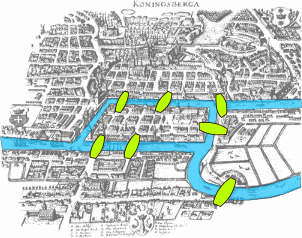 |
| Image from Wikipedia |
In the paper, Euler studied the following question: is it possible to walk through the city crossing each bridge exactly once? As it turns out, for the city of Königsberg, the answer is no. To reach this answer, Euler developed a general approach to represent any layout of landmasses and bridges in terms of what he dubbed the Geometriam Situs (the “Geometry of Place”), which we now call Graph Theory. He represented each landmass as a “node” in the graph, and each bridge as an “edge,” like this:
 |
| Image from Wikipedia |
Euler noticed that if all the nodes in the graph have an even number of edges (such graphs are called “Eulerian” in his honor) then, and only then, a cycle can be found that visits every edge exactly once. Keep this in mind, as we’ll rely on this fact later in the post.
Read original articleTags:


