





Menu
Blog Archives
Fifth Circuit Holds Class Arbitration is a Gateway Issue for the Courts to Decide
August 20, 2019
The United States Court of Appeals for the Fifth Circuit has issued an opinion holding the issue of class arbitration is a gateway matter for the courts to decide. In 20/20 Communications, Inc. v. Crawford, No. 18-10260 (5th Cir., July 22, 2019), a number of employees signed 20/20 Communication’s arbitration agreementas a condition of employment. The terms of the agreement required each employee to individually arbitrate any future claims against the company. Several...
August 20, 2019
The United States Court of Appeals for the Fifth Circuit has issued an opinion holding the issue of class arbitration is a gateway matter for the courts to decide. In 20/20 Communications, Inc. v. Crawford, No. 18-10260 (5th Cir., July 22, 2019), a number of employees signed 20/20 Communication’s arbitration agreementas a condition of employment. The terms of the agreement required each employee to individually arbitrate any future claims against the company. Several...

Everything You Ever Wanted to Know About Copyright Registrations Over Time
August 19, 2019
A recent paper reports results from the authors' effort to build what now has to be the single largest U.S. Copyright registration...
August 19, 2019
A recent paper reports results from the authors' effort to build what now has to be the single largest U.S. Copyright registration...
Fifth Circuit Withdraws Prior Opinion in Case Involving Arbitration
August 16, 2019
The United States Court of Appeals for the Fifth Circuit has withdrawn its earlier opinion following a second rehearing of a case involving arbitration. In Stemcor USA Inc. v. Cia Siderurgica do Para Cosipar, et al., No. 16-30984 (June 25, 2019), two foreign corporate creditors, Daewoo and Thyssenkrupp Mannex GMBH (“TKM”), sought to attach the same pig iron that was owned by America Metals Trading, LLP (“AMT”) after AMT apparently failed to comply with its separate contractual...
August 16, 2019
The United States Court of Appeals for the Fifth Circuit has withdrawn its earlier opinion following a second rehearing of a case involving arbitration. In Stemcor USA Inc. v. Cia Siderurgica do Para Cosipar, et al., No. 16-30984 (June 25, 2019), two foreign corporate creditors, Daewoo and Thyssenkrupp Mannex GMBH (“TKM”), sought to attach the same pig iron that was owned by America Metals Trading, LLP (“AMT”) after AMT apparently failed to comply with its separate contractual...
CMS Issues Final Rule Allowing Pre-Dispute Nursing Home Arbitration Agreements
August 15, 2019
The Centers for Medicare & Medicaid Services (“CMS”) has issued a final rule allowing the use of pre-dispute, binding arbitration agreements by nursing homes across the United States. The rule summary published in the Federal Register on July 18th states: This final rule amends the requirements that Long-Term Care (LTC) facilities must meet to participate in the Medicare and Medicaid programs. Specifically, we are repealing the prohibition...
August 15, 2019
The Centers for Medicare & Medicaid Services (“CMS”) has issued a final rule allowing the use of pre-dispute, binding arbitration agreements by nursing homes across the United States. The rule summary published in the Federal Register on July 18th states: This final rule amends the requirements that Long-Term Care (LTC) facilities must meet to participate in the Medicare and Medicaid programs. Specifically, we are repealing the prohibition...
Attorney Fees and Arbitrability Addressed by New York Appellate Court
August 14, 2019
In Steyn v. CRTV, LLC (In re Steyn), ____ A.D. 3d ____, 2019 N.Y. Slip Op. 5341, at *1 (1st Dep’t July 2, 2019), New York’s Appellate Division, First Department decided a case falling under the Federal Arbitration Act (the “FAA”) that involved two challenges: one to an award of attorney fees on manifest disregard of the law grounds, and the other to an award that a nonsignatory obtained by joining the petitioner’s counterclaim. The Court rejected the manifest-disregard challenge...
August 14, 2019
In Steyn v. CRTV, LLC (In re Steyn), ____ A.D. 3d ____, 2019 N.Y. Slip Op. 5341, at *1 (1st Dep’t July 2, 2019), New York’s Appellate Division, First Department decided a case falling under the Federal Arbitration Act (the “FAA”) that involved two challenges: one to an award of attorney fees on manifest disregard of the law grounds, and the other to an award that a nonsignatory obtained by joining the petitioner’s counterclaim. The Court rejected the manifest-disregard challenge...
The Fifth Circuit Weighs in About Who Decides Class Arbitrability
August 13, 2019
The Fifth Circuit just deepened (and confused) a Circuit split over the question of who decides whether an arbitration agreement permits class proceedings. See 20/20 Communications, Incorporated v. Crawford, 2019 WL 3281412 (5th Cir. July 22, 2019). Liz has written about the split here, here, and here. (You might also recall that SCOTUS flagged this issue, though it punted on it, in Lamps Plus, Inc. v. Varela, 139 S. Ct. 1407, 1417 n.4, 203 L.Ed.2d 636 (2019)...
August 13, 2019
The Fifth Circuit just deepened (and confused) a Circuit split over the question of who decides whether an arbitration agreement permits class proceedings. See 20/20 Communications, Incorporated v. Crawford, 2019 WL 3281412 (5th Cir. July 22, 2019). Liz has written about the split here, here, and here. (You might also recall that SCOTUS flagged this issue, though it punted on it, in Lamps Plus, Inc. v. Varela, 139 S. Ct. 1407, 1417 n.4, 203 L.Ed.2d 636 (2019)...
Moffitt on Settlement Malpractice
August 12, 2019
I have been totally remiss in singing the praises of Michael’s new article coming out shortly in the University of Chicago Law Reviewand now, as I am getting ready for class and rereading it, I want to recommend it even more. It’s wonderful empirical work–both creative and comprehensive–with a real impact for what lawyers should know and policy-makers should find troubling. I’ll be teaching this in both my ADR and Ethics classes. Here is the link. And here...
August 12, 2019
I have been totally remiss in singing the praises of Michael’s new article coming out shortly in the University of Chicago Law Reviewand now, as I am getting ready for class and rereading it, I want to recommend it even more. It’s wonderful empirical work–both creative and comprehensive–with a real impact for what lawyers should know and policy-makers should find troubling. I’ll be teaching this in both my ADR and Ethics classes. Here is the link. And here...
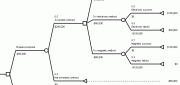
The 37% Rule: How to Decide When to Stop Wondering and Start Deciding
August 11, 2019
Earlier this year, I read Algorithms to Live By, a book that explains how to use insights from computer science...
August 11, 2019
Earlier this year, I read Algorithms to Live By, a book that explains how to use insights from computer science...
Why And How Lawyers And Law Schools Should Embrace Artificial Intelligence
August 10, 2019
Conclusion. There are several statistics floating around as to how much of a lawyer's current tasks will be automated in the near future. "Deloitte claims 39% of legal jobs can be automated; McKinsey Global Institute estimates that 23% of a lawyer's job could be automated. Some estimates suggest that adopting all legal technology (including AI) already available now would reduce lawyers' hours by 13%." As discussed in this essay, there are a great number of Al programs currently in existence...
August 10, 2019
Conclusion. There are several statistics floating around as to how much of a lawyer's current tasks will be automated in the near future. "Deloitte claims 39% of legal jobs can be automated; McKinsey Global Institute estimates that 23% of a lawyer's job could be automated. Some estimates suggest that adopting all legal technology (including AI) already available now would reduce lawyers' hours by 13%." As discussed in this essay, there are a great number of Al programs currently in existence...
Fifth Circuit Overturns W.D. Texas Order Compelling Arbitration in FLSA Case
August 9, 2019
The nation’s Fifth Circuit Court of Appeals has reversed a Texas federal court’s order compelling an at-will employee to arbitrate a pay dispute with her employer. In Trammell v. AccentCare, Inc., No. 18-50872 (5th Cir., June 7, 2019), a woman, Trammell, provided in-home personal care assistance services for a home healthcare provider, AccentCare, for several years as an at-will employee. In 2016, the company apparently mailed an arbitration agreement to...
August 9, 2019
The nation’s Fifth Circuit Court of Appeals has reversed a Texas federal court’s order compelling an at-will employee to arbitrate a pay dispute with her employer. In Trammell v. AccentCare, Inc., No. 18-50872 (5th Cir., June 7, 2019), a woman, Trammell, provided in-home personal care assistance services for a home healthcare provider, AccentCare, for several years as an at-will employee. In 2016, the company apparently mailed an arbitration agreement to...


