





Court Enforces Arbitration Clause in “Modified Clickwrap”–Chen v. Sierra Trading Post
This post has been viewed 5,631 times.
In general, courts try to divide contracts into either clickwraps or browsewraps. A reminder that I only use those terms to mock them for several reasons, including (1) those terms are not robust enough to cover the range of UIs encountered in the field; and (2) the classification does not always help courts reach a conclusion. As the court candidly acknowledges, the “relevant law shows that courts have not been uniform in their treatment of ‘clickwrap’ or ‘browsewrap’ agreements.”
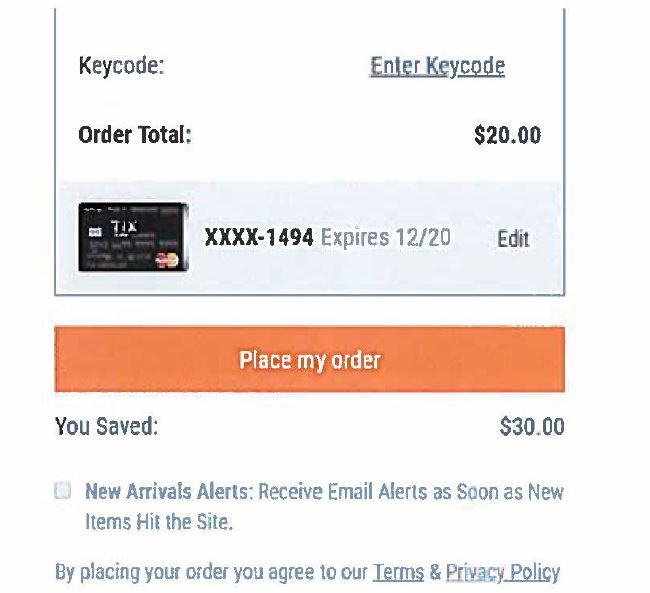
Like so many courts before, this court says this UI isn’t either a clickwrap or browsewrap. Instead, the court calls this UI a “modified clickwrap,” a phrase we’ve seen before. The court says the defendant’s UI sufficiently confers inquiry notice on the plaintiff:
Read original articleNotably, the user does not need to scroll beyond the “Place my Order” button to find the Consent line, which explicitly states that the user agrees to the “Terms” by placing the purchase order. [cite to Meyer v. Uber] Moreover, the word “Term” in the Consent line, which hyperlinks directly to the TOU, is both capitalized and underlined and thus distinguishable from the surrounding text.
Tags:


