


Menu
Neuroscience
The Thirsty Mind
October 16, 2014
The latest issue of the journal Nature Neuroscience includes an article by a group of researchers from the Centre for Neural Circuits and Behaviour, at Oxford. The group, which is led by Scott Waddell, studies rewards, motivation, and memory in the comparatively simple brain of the fruit fly. Drosophila melanogaster has been a tiny laboratory workhorse for more than a century, ever since it helped prove the theory of chromosomal inheritance. There are about a hundred thousand neurons in the fruit-fly...
“Why Nudge? The Politics of Libertarian Paternalism” by Sunstein
October 8, 2014
The Legal Theory Bookworm recommends Why Nudge?: The Politics of Libertarian Paternalism (The Storrs Lectures Series) by Cass Sunstein. Here is a description: Based on a series of pathbreaking lectures given at Yale University in 2012, this powerful, thought-provoking work by national best-selling author Cass R. Sunstein combines legal theory with behavioral economics to make a fresh argument about the legitimate scope of government, bearing on obesity, smoking, distracted driving, health care,...
Curiosity Is as Important as Intelligence
October 1, 2014
There seems to be wide support for the idea that we are living in an “age of complexity”, which implies that the world has never been more intricate. This idea is based on the rapid pace of technological changes, and the vast amount of information that we are generating (the two are related). Yet consider that philosophers like Leibniz (17th century) and Diderot (18th century) were already complaining about information overload. The “horrible mass of books” they referred to may have represented...
How Improving Decision-Making and Mindfulness Can Improve Legal Ethics and Professionalism
October 1, 2014
Lawyers who behave unethically and unprofessionally do so for various reasons, ranging from intention to carelessness. Lawyer misconduct can also result from decision-making flaws. Psychologist Chip Heath and his brother Dan Heath, in their best-selling book, Decisive: How to Make Better Decisions in Life and Work, suggest a process to improve people’s decision-making. They introduce the acronym WRAP as the mnemonic for these decision-making heuristics: (1) Widen your options, (2) Reality-test...
Latitudes of Acceptance
September 9, 2014
I'll tell you about my new favorite idea, which like all new favorite ideas, is really an old idea. This one, from the 1960s, was used only in a couple of studies. It's called "latitude of acceptance". If I want to persuade you, what I need to do is pitch my arguments so that they're in the range of a bubble around your current belief; it's not too far from your current belief, but it's within this bubble. If your belief is that you're really, really anti-guns, let's say, and I want to move you a bit,...
Two New Books on Changing the Brain Through Learning
June 13, 2014
Does resolving conflict require learning? Typically, yes, of course. If no one in the dispute learns anything new, the conflict will probably remain unresolved. That's one of the reasons learning is often mentioned here at BonP. In May, I attended the 26th annual convention of the Association of Psychological Science; some of the presentations I chose among the multitude offered included learning as a focus. One of my favorite programs, and certainly the most entertaining, was one copresented...
Inside the Strange New World of DIY Brain Stimulation
June 8, 2014
Entrepreneurs are starting to get in on the action. A company called foc.us has already planted a flag with a commercial brain-stimulation headset released last year. It’s marketed as a gadget for videogamers looking to improve their skills, thus skirting the need for FDA approval. The first batch of 3,000 sold out in just a few months. So did the second. With easy access to the research, the equipment, and each other, self-experimenters aren’t consulting their doctors or waiting for scientific...
The Unfinished Science Behind the New Wave of Electrical Brain Stimulation
June 8, 2014
Ever since the physician Scribonius Largus slapped an electric torpedo fish on the forehead of a headache sufferer in the early days of the Roman empire, electricity has been pursued as a cure for a seemingly endless variety of ailments–by serious scientists and profiteering quacks alike. The latest chapter in this long and colorful history (see sidebar below) involves something called transcranial direct current stimulation, in which a small electric current is delivered to the brain through electrodes...

Incredible 3-D Map Shows 300,000 Molecules in a Single Synapse
June 7, 2014
Synapses are the key to communication inside the brain. These microscopic gaps are where signals jump from one neuron to another....
June 7, 2014
Synapses are the key to communication inside the brain. These microscopic gaps are where signals jump from one neuron to another....
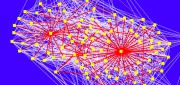
Biologists Find New Rules for Life at the Edge of Chaos
June 6, 2014
In the space between order and chaos, a zone usually described with the mathematics of impending avalanches and crystallizing...
June 6, 2014
In the space between order and chaos, a zone usually described with the mathematics of impending avalanches and crystallizing...