





Menu
Cognitive
The Weird Reason Sleep Is So Good For Memory
December 25, 2017
How sleep helps us adapt our memories for future experiences. Sleep helps to strengthen both old and new versions of an experience, new research shows. Instead of overwriting old versions of a memory, the brain stores another copy of the same experience. Sleep keeps both old and new memories alive, which gives memory more flexibility. Dr Scott Cairney, who led the research said: “Previous studies have shown sleep’s importance for memory. Our research takes this a step further...
December 25, 2017
How sleep helps us adapt our memories for future experiences. Sleep helps to strengthen both old and new versions of an experience, new research shows. Instead of overwriting old versions of a memory, the brain stores another copy of the same experience. Sleep keeps both old and new memories alive, which gives memory more flexibility. Dr Scott Cairney, who led the research said: “Previous studies have shown sleep’s importance for memory. Our research takes this a step further...
Why Do We Crave? The Science Behind Food Cravings
December 24, 2017
According to the Merriam-Webster Dictionary, a craving is a “very strong desire for something.” You could crave a donut, a glass of wine, or a cigarette. Even sex. All of us have felt like slaves to our food cravings at some point — it’s just a matter of how long until we give in. The million-dollar question: How do food cravings work? Our evolutionary history provides some clues. “Our brains evolved to respond to food whenever the opportunity was available, especially if the food was palatable...
December 24, 2017
According to the Merriam-Webster Dictionary, a craving is a “very strong desire for something.” You could crave a donut, a glass of wine, or a cigarette. Even sex. All of us have felt like slaves to our food cravings at some point — it’s just a matter of how long until we give in. The million-dollar question: How do food cravings work? Our evolutionary history provides some clues. “Our brains evolved to respond to food whenever the opportunity was available, especially if the food was palatable...
New Report on Legal Industry Outlook Says “AI” Will Create “Supercharged” Lawyers
December 20, 2017
For several years legal industry commentators like Richard Susskind have been predicting that technology in the form of Artificial Intelligence ("AI") will wind up replacing some lawyers when it comes to many of the routine tasks they now perform thereby further depressing the job market for new graduates. So far, the reality has not been as dire as the predictions. A new report by legal consulting firm Major, Lindsey & Africa says that, at least for the near term, they don't anticipate...
December 20, 2017
For several years legal industry commentators like Richard Susskind have been predicting that technology in the form of Artificial Intelligence ("AI") will wind up replacing some lawyers when it comes to many of the routine tasks they now perform thereby further depressing the job market for new graduates. So far, the reality has not been as dire as the predictions. A new report by legal consulting firm Major, Lindsey & Africa says that, at least for the near term, they don't anticipate...
Expressing Gratitude in Negotiations May Not Be A Good Idea
December 15, 2017
Previous research has revealed that expressing gratitude motivates prosocial behavior in cooperative relationships. However, expressing gratitude in competitive interactions may operate differently. Across five studies, we demonstrate that individuals interacting with grateful counterparts become more likely to engage in selfish behavior during competitive interactions. In Studies 1a and 1b, participants who interacted with counterparts expressing gratitude were more likely to make aggressive offers...
December 15, 2017
Previous research has revealed that expressing gratitude motivates prosocial behavior in cooperative relationships. However, expressing gratitude in competitive interactions may operate differently. Across five studies, we demonstrate that individuals interacting with grateful counterparts become more likely to engage in selfish behavior during competitive interactions. In Studies 1a and 1b, participants who interacted with counterparts expressing gratitude were more likely to make aggressive offers...
Anger Has Its Benefits
December 14, 2017
From this, the researchers concluded that “‘People intuitively chose to become angry… They believed they would become more effective competitors.’” (Id.): They were right. Anger is what psychologists call an ‘approach’ emotion—it makes us move toward or attack something. It can help us tackle problems, such as when we get mad about something political and rally to a cause. And getting made before a negotiation, competition or sporting event can fire us up. That’s why coaches trash...
December 14, 2017
From this, the researchers concluded that “‘People intuitively chose to become angry… They believed they would become more effective competitors.’” (Id.): They were right. Anger is what psychologists call an ‘approach’ emotion—it makes us move toward or attack something. It can help us tackle problems, such as when we get mad about something political and rally to a cause. And getting made before a negotiation, competition or sporting event can fire us up. That’s why coaches trash...
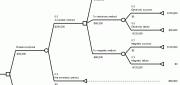
Litigation Risk Assessment: A Tool to Enhance Negotiation
December 12, 2017
Comparisons between final settlement offers and trial outcomes raise serious questions about whether lawyers and clients...
December 12, 2017
Comparisons between final settlement offers and trial outcomes raise serious questions about whether lawyers and clients...
How A Tired Mind Limits the Body
December 8, 2017
But even here the body/mind distinction proves illusory. Consider a new paper by Daniel Longman, Jay Stock and Jonathan Wells. Their subjects were sixty-two male rowers from the University of Cambridge. They were all in excellent shape. On their first visit to the lab, the men rowed as intensely as possible for three minutes as the scientists tracked their total power output. On their second visit, the men were given an arduous mental task. Seventy-five words were briefly flashed on a screen; their...
December 8, 2017
But even here the body/mind distinction proves illusory. Consider a new paper by Daniel Longman, Jay Stock and Jonathan Wells. Their subjects were sixty-two male rowers from the University of Cambridge. They were all in excellent shape. On their first visit to the lab, the men rowed as intensely as possible for three minutes as the scientists tracked their total power output. On their second visit, the men were given an arduous mental task. Seventy-five words were briefly flashed on a screen; their...
How to Control Your Emotions During a Difficult Conversation
December 7, 2017
It’s hard not to get worked up emotionally when you’re in a tense conversation. After all, a disagreement can feel like a threat. You’re afraid you’re going to have to give up something — your point of view, the way you’re used to doing something, the notion that you’re right, or maybe even power – and your body therefore ramps up for a fight by triggering the sympathetic nervous system. This is a natural response, but the problem is that our bodies and minds aren’t particularly...
December 7, 2017
It’s hard not to get worked up emotionally when you’re in a tense conversation. After all, a disagreement can feel like a threat. You’re afraid you’re going to have to give up something — your point of view, the way you’re used to doing something, the notion that you’re right, or maybe even power – and your body therefore ramps up for a fight by triggering the sympathetic nervous system. This is a natural response, but the problem is that our bodies and minds aren’t particularly...
Listening Leads to Empathy
December 1, 2017
Have you ever sat back with your eyes closed and listened to music or someone speaking? Why did you do it? Probably, to appreciate more fully and deeply what you were hearing. By shutting down one of our senses, we allow ourselves to hone in more deeply to the music or conversation. Well, you are not crazy for doing this. A recent study, posted on LiveScience.com (posted on October 10, 2017 entitled Listen, Don’t Look: Why Your Ears Can Tell More Than Your Eyes by Samantha Mattewson) reveals...
December 1, 2017
Have you ever sat back with your eyes closed and listened to music or someone speaking? Why did you do it? Probably, to appreciate more fully and deeply what you were hearing. By shutting down one of our senses, we allow ourselves to hone in more deeply to the music or conversation. Well, you are not crazy for doing this. A recent study, posted on LiveScience.com (posted on October 10, 2017 entitled Listen, Don’t Look: Why Your Ears Can Tell More Than Your Eyes by Samantha Mattewson) reveals...
Real Car Dealing
November 29, 2017
I just listened to an episode of a This American Life podcast entitled 129 Cars, referring to a car dealership’s monthly sales quota. A team of reporters followed various people at a Long Island dealership for a month and the episode sounds like a sitcom. But it is very real, reflecting tensions in negotiations between the manufacturer and the dealership as well as between various employees at the dealership — not to mention tension between the dealership and the customers. This...
November 29, 2017
I just listened to an episode of a This American Life podcast entitled 129 Cars, referring to a car dealership’s monthly sales quota. A team of reporters followed various people at a Long Island dealership for a month and the episode sounds like a sitcom. But it is very real, reflecting tensions in negotiations between the manufacturer and the dealership as well as between various employees at the dealership — not to mention tension between the dealership and the customers. This...


