





Menu
Cognitive
Different Ways of Seeing The Same Thing!
April 26, 2018
In a March 13, 2018 post, LiveScience.com contributor Jasmin Malik Chua published an article on the value of optical illusions. Entitled “What This Optical Illusion Reveals About the Human Brain”, Ms. Chua replicates a 19th century optical illusion which can be either a rabbit or a duck, but not both at the same time. She explains: “…First published in 1892 by a German humor magazine, the figure was made popular after the philosopher Ludwig Wittgenstein used it to illustrate two ways of seeing....
April 26, 2018
In a March 13, 2018 post, LiveScience.com contributor Jasmin Malik Chua published an article on the value of optical illusions. Entitled “What This Optical Illusion Reveals About the Human Brain”, Ms. Chua replicates a 19th century optical illusion which can be either a rabbit or a duck, but not both at the same time. She explains: “…First published in 1892 by a German humor magazine, the figure was made popular after the philosopher Ludwig Wittgenstein used it to illustrate two ways of seeing....

Keet, Heavin, & Sparrow on the Psychological Cost of Civil Litigation
April 25, 2018
Michaela Keet, Heather D. Heavin and Shawna Sparrow (University of Saskatchewan College of Law, University of Saskatchewan...
April 25, 2018
Michaela Keet, Heather D. Heavin and Shawna Sparrow (University of Saskatchewan College of Law, University of Saskatchewan...
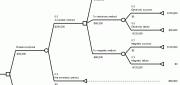
Heavin & Keet on Litigation Risk Analysis & Settlement
April 25, 2018
Heather D. Heavin and Michaela Keet (University of Saskatchewan and University of Saskatchewan College of Law) has posted Litigation...
April 25, 2018
Heather D. Heavin and Michaela Keet (University of Saskatchewan and University of Saskatchewan College of Law) has posted Litigation...
On Preferring A to B, While Also Preferring B to A
April 24, 2018
In important contexts, people prefer option A to option B when they evaluate the two separately, but prefer option B to option A when they evaluate the two jointly. In consumer behavior, politics, and law, such preference reversals are often a product of the pervasive problem of "evaluability." Some important characteristics of options are difficult or impossible to assess in separate evaluation, and hence choosers disregard or downplay them; those characteristics are much easier to assess in joint...
April 24, 2018
In important contexts, people prefer option A to option B when they evaluate the two separately, but prefer option B to option A when they evaluate the two jointly. In consumer behavior, politics, and law, such preference reversals are often a product of the pervasive problem of "evaluability." Some important characteristics of options are difficult or impossible to assess in separate evaluation, and hence choosers disregard or downplay them; those characteristics are much easier to assess in joint...
Dirty Tricks in Mediation
April 24, 2018
For a person dealing with conflict and training people in principled WIN-WIN negotiation, it is always very frustrating to meet with dirty tricks in negotiation. Those inherently adversarial unethical (and/or not broadly accepted as ethical) negotiation ploys misuse some of the cognitive biases in favour of the active party to the detriment of the opposing party. The most common commonly known dirty trick would be walkouts but there are some more sophisticated ones as calling higher authority and bad...
April 24, 2018
For a person dealing with conflict and training people in principled WIN-WIN negotiation, it is always very frustrating to meet with dirty tricks in negotiation. Those inherently adversarial unethical (and/or not broadly accepted as ethical) negotiation ploys misuse some of the cognitive biases in favour of the active party to the detriment of the opposing party. The most common commonly known dirty trick would be walkouts but there are some more sophisticated ones as calling higher authority and bad...
Apologies & Remedial Mismatches
April 22, 2018
While the context is admittedly horrific--victims of sexual abuse and the Catholic Church--data from the Netherlands, which in 2011 implemented a victim-friendly procedure for victims of sexual abuse by the Catholic Church, provide truly unique insights into "whether and how nonmonetary needs can be addressed within the context of tort law and compensation funds, as the decisions include information on why victims initiated the procedure and what types of relief (e.g., an apology, recognition of their...
April 22, 2018
While the context is admittedly horrific--victims of sexual abuse and the Catholic Church--data from the Netherlands, which in 2011 implemented a victim-friendly procedure for victims of sexual abuse by the Catholic Church, provide truly unique insights into "whether and how nonmonetary needs can be addressed within the context of tort law and compensation funds, as the decisions include information on why victims initiated the procedure and what types of relief (e.g., an apology, recognition of their...
For Lance Armstrong, Backing Down Might Have Hurt More Than Paying $5 Million
April 20, 2018
Lance Armstrong just avoided a trial that could have ended with his financial ruin. He reached a settlement of $5 million, the amount his lawyers offered the federal government almost five years ago to make amends for Armstrong’s use of performance-enhancing drugs while he was sponsored by the United States Postal Service. In the end, a mediator told both sides that $5 million was the magic number. The government, which had demanded at least $10 million to settle, took that advice and gained...
April 20, 2018
Lance Armstrong just avoided a trial that could have ended with his financial ruin. He reached a settlement of $5 million, the amount his lawyers offered the federal government almost five years ago to make amends for Armstrong’s use of performance-enhancing drugs while he was sponsored by the United States Postal Service. In the end, a mediator told both sides that $5 million was the magic number. The government, which had demanded at least $10 million to settle, took that advice and gained...
Separate the People from the Problem – or the Person from the Action. Strategy or Compassion? In Theory and in Practice
April 19, 2018
In some mediations, I ask myself why people so resolutely retain their anger, their bitterness, or their hurt for such long periods of time. Often mediation takes place only after a conflict has escalated and hardened and been going on for a while, in some cases many years. If feelings of anger and bitterness persist over years, I can’t help but feeling that this is a sad way to spend your life. And often, it is the people who have felt this way for a long time who do not leave mediation much changed,...
April 19, 2018
In some mediations, I ask myself why people so resolutely retain their anger, their bitterness, or their hurt for such long periods of time. Often mediation takes place only after a conflict has escalated and hardened and been going on for a while, in some cases many years. If feelings of anger and bitterness persist over years, I can’t help but feeling that this is a sad way to spend your life. And often, it is the people who have felt this way for a long time who do not leave mediation much changed,...

We’re Teaching Grit the Wrong Way
April 15, 2018
This is an article worth reading in the Chronicle of Higher Ed by David DeSteno, a professor of psychology at Northeastern...
April 15, 2018
This is an article worth reading in the Chronicle of Higher Ed by David DeSteno, a professor of psychology at Northeastern...
How To Read Someone’s Emotions With 90% Accuracy
April 1, 2018
How neuroscientists are learning to predict emotions with increasing accuracy. Brain scans can read human emotions with 90% accuracy, a new study finds. Researchers have been able to predict the intensity of negative emotions to evocative images. They found that negative emotions have a ‘neural signature’ which a computer could learn.
April 1, 2018
How neuroscientists are learning to predict emotions with increasing accuracy. Brain scans can read human emotions with 90% accuracy, a new study finds. Researchers have been able to predict the intensity of negative emotions to evocative images. They found that negative emotions have a ‘neural signature’ which a computer could learn.


