





Menu
Blog Archives
Action To Vacate Arbitral Award Dismissed For Lack Of Subject-Matter Jurisdiction
October 12, 2015
A disappointed claimant in a FINRA arbitration filed suit under section 10 of the Federal Arbitration Act (“FAA”) in United States District Court to vacate the arbitral award. The court dismissed the case for lack of subject-matter jurisdiction. The court noted the well established principle that the FAA is not itself a source of subject-matter jurisdiction. Stating that the parties were not diverse, the court proceeded to evaluate whether it could exercise subject-matter jurisdiction based...
October 12, 2015
A disappointed claimant in a FINRA arbitration filed suit under section 10 of the Federal Arbitration Act (“FAA”) in United States District Court to vacate the arbitral award. The court dismissed the case for lack of subject-matter jurisdiction. The court noted the well established principle that the FAA is not itself a source of subject-matter jurisdiction. Stating that the parties were not diverse, the court proceeded to evaluate whether it could exercise subject-matter jurisdiction based...
Appearances Really Do Matter!
October 12, 2015
We have all heard that how we appear matters: that people judge us by our appearance without even realizing it. People will look at our faces and based on what they perceive unconsciously, will decide whether we are trustworthy. A recent study confirms this link between appearance and trustworthiness. In the July 25, 2015 edition of The Economist (and reported on other websites as well), the author of “Looks Could Kill” reports on a study by John Wilson and Nicholas Rule, psychologists at the University...
October 12, 2015
We have all heard that how we appear matters: that people judge us by our appearance without even realizing it. People will look at our faces and based on what they perceive unconsciously, will decide whether we are trustworthy. A recent study confirms this link between appearance and trustworthiness. In the July 25, 2015 edition of The Economist (and reported on other websites as well), the author of “Looks Could Kill” reports on a study by John Wilson and Nicholas Rule, psychologists at the University...

What People in 1900 Thought the Year 2000 Would Look Like
October 11, 2015
There are few things as fascinating as seeing what people in the past dreamed about the future. "France in the Year 2000"...
October 11, 2015
There are few things as fascinating as seeing what people in the past dreamed about the future. "France in the Year 2000"...
Cass Sunstein: In Praise of Law Reviews
October 11, 2015
Cass Sunstein (Harvard) has posted his essay, "In Praise of Law Reviews (And Jargon-Filled, Academic Writing)," on SSRN. The abstract reads: Many people, including many lawyers and judges, disparage law reviews (and the books that sometimes result from them) on the ground that they often deal with abstruse topics, of little interest to the bar, and are sometimes full of jargon-filled, excessively academic, and sometimes impenetrable writing. Some of the objections are warranted, but at their best,...
October 11, 2015
Cass Sunstein (Harvard) has posted his essay, "In Praise of Law Reviews (And Jargon-Filled, Academic Writing)," on SSRN. The abstract reads: Many people, including many lawyers and judges, disparage law reviews (and the books that sometimes result from them) on the ground that they often deal with abstruse topics, of little interest to the bar, and are sometimes full of jargon-filled, excessively academic, and sometimes impenetrable writing. Some of the objections are warranted, but at their best,...
When the Wealthy Divorce, They Regularly Engage Forensic Accountants
October 11, 2015
From Forbes: Worldwide, the use of forensic accountants by the wealthy – especially the ultra-wealthy – is increasing. This is a trend that is likely to only accelerate. There are a number of different reasons the wealthy engage forensic accountants. Often, when the wealthy bring in a forensic accountant, it’s to address business concerns. The questionable practices of business partners might very well prompt the hiring of a forensic accountant. Relatively speaking, a burgeoning need by the wealthy...
October 11, 2015
From Forbes: Worldwide, the use of forensic accountants by the wealthy – especially the ultra-wealthy – is increasing. This is a trend that is likely to only accelerate. There are a number of different reasons the wealthy engage forensic accountants. Often, when the wealthy bring in a forensic accountant, it’s to address business concerns. The questionable practices of business partners might very well prompt the hiring of a forensic accountant. Relatively speaking, a burgeoning need by the wealthy...
New Website Promises to Handle Your Divorce and Filing Costs for $99
October 10, 2015
From TIME: A new website aims to take much of the heartache and cost out of getting a divorce by conducting the whole process online. Presented at TechCrunch Disrupt in San Francisco on Tuesday, Separate.us, founded by Sandro Tuzzo and Larry Maloney, aims to distill legal jargon into plain language and reduce legal fees from tens of thousands of dollars to base price of around $1,500. Initial filing costs just $99. “Today, connecting is easy. There’s tons of software applications out there...
October 10, 2015
From TIME: A new website aims to take much of the heartache and cost out of getting a divorce by conducting the whole process online. Presented at TechCrunch Disrupt in San Francisco on Tuesday, Separate.us, founded by Sandro Tuzzo and Larry Maloney, aims to distill legal jargon into plain language and reduce legal fees from tens of thousands of dollars to base price of around $1,500. Initial filing costs just $99. “Today, connecting is easy. There’s tons of software applications out there...

Breaking the Taxi Monoply
October 10, 2015
How fast do profits erode once the entry barrier to Uber is lifted? Enough to dissipate one-third of the value of operating...
October 10, 2015
How fast do profits erode once the entry barrier to Uber is lifted? Enough to dissipate one-third of the value of operating...
The Art of Asking Questions
October 10, 2015
Mediation is sometimes referred to as “the art of asking questions.” One of my mediation teachers, David Matz, described this process as similar to fishing – we cast our questions on the waters of the conflict, and sometimes we catch a fish (i.e., a really useful answer)! Our goal in asking questions is to understand people’s stories, discern their underlying interests, and explore the feasibility of various settlement options. Curiosity is an essential trait for mediators. For negotiators,...
October 10, 2015
Mediation is sometimes referred to as “the art of asking questions.” One of my mediation teachers, David Matz, described this process as similar to fishing – we cast our questions on the waters of the conflict, and sometimes we catch a fish (i.e., a really useful answer)! Our goal in asking questions is to understand people’s stories, discern their underlying interests, and explore the feasibility of various settlement options. Curiosity is an essential trait for mediators. For negotiators,...
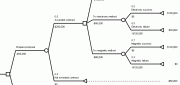
Online Legal Modeling (Decision Tree) Course
October 10, 2015
n just one hour, you can gain proficiency in building and analyzing TreeAge Pro models to assess litigation risk. The...
October 10, 2015
n just one hour, you can gain proficiency in building and analyzing TreeAge Pro models to assess litigation risk. The...
Silicon Chips Could Become Carbon Chips
October 9, 2015
IBM says it has solved one of three key problems with making computer chip transistors from carbon rather than silicon. It’s a step closer to overcoming the current limitations on Moore’s Law. The theory is that while silicon transistors have worked well for years, it’s getting harder and harder to make them any smaller and thus increase the overall capacity on a chip. The suggested alternative is a carbon nanotube, literally a rolled up sheet of carbon that is just one atom thick. One...
October 9, 2015
IBM says it has solved one of three key problems with making computer chip transistors from carbon rather than silicon. It’s a step closer to overcoming the current limitations on Moore’s Law. The theory is that while silicon transistors have worked well for years, it’s getting harder and harder to make them any smaller and thus increase the overall capacity on a chip. The suggested alternative is a carbon nanotube, literally a rolled up sheet of carbon that is just one atom thick. One...


