





Menu
Blog Archives
FY 2016 Funding Meets Judiciary Needs
December 23, 2015
The Consolidated Appropriations Act of 2016 omnibus appropriations bill passed by Congress contains $6.78 billion in discretionary funding for the federal Judiciary, a 1.2 percent increase from the previous year and essentially equal to the Judiciary’s final budget request. James C. Duff, Director of the Administrative Office of the U.S. Courts, said, “Final FY 2016 funding for the federal courts and to GSA for our courthouse construction program reflect the hard work and strong leadership...
December 23, 2015
The Consolidated Appropriations Act of 2016 omnibus appropriations bill passed by Congress contains $6.78 billion in discretionary funding for the federal Judiciary, a 1.2 percent increase from the previous year and essentially equal to the Judiciary’s final budget request. James C. Duff, Director of the Administrative Office of the U.S. Courts, said, “Final FY 2016 funding for the federal courts and to GSA for our courthouse construction program reflect the hard work and strong leadership...
Gilstrap Slams Patent Plaintiff In Big Ruling
December 23, 2015
Gilstrap ruled that eDekka, a Plano-based, nonpracticing entity and a serial Eastern District plaintiff, pursued an infringement claim on an "obviously weak patent" for the purpose of extracting small "nuisance value settlements" from numerous defendants with no intention of trying their cases. Gilstrap concluded in his Dec. 17 order in eDekka v. 3Balls.com that eDekka's case was "exceptional" under 35 U.S.C. §285—a law that allows federal judges to award attorney fees against patent parties...
December 23, 2015
Gilstrap ruled that eDekka, a Plano-based, nonpracticing entity and a serial Eastern District plaintiff, pursued an infringement claim on an "obviously weak patent" for the purpose of extracting small "nuisance value settlements" from numerous defendants with no intention of trying their cases. Gilstrap concluded in his Dec. 17 order in eDekka v. 3Balls.com that eDekka's case was "exceptional" under 35 U.S.C. §285—a law that allows federal judges to award attorney fees against patent parties...
Donations, Deans and Dwindling Enrollment: The Year in Law Schools
December 23, 2015
Here are 10 of The National Law Journal’s top stories on law schools and legal education in 2015. Law School Enrollment Slumps 5 Percent Enrollment in the nation’s law schools dropped nearly 5 percent in 2015, including a slump by 2.2 percent in first-year class sizes, according to data provided by the American Bar Association. Although total enrollment for Juris Doctor degrees is down by nearly 6,000 to 113,900 this year, total first-year matriculation is more of a mixed bag. Ninety-seven...
December 23, 2015
Here are 10 of The National Law Journal’s top stories on law schools and legal education in 2015. Law School Enrollment Slumps 5 Percent Enrollment in the nation’s law schools dropped nearly 5 percent in 2015, including a slump by 2.2 percent in first-year class sizes, according to data provided by the American Bar Association. Although total enrollment for Juris Doctor degrees is down by nearly 6,000 to 113,900 this year, total first-year matriculation is more of a mixed bag. Ninety-seven...
How Many of Your Daily Tasks Could Be Automated?
December 22, 2015
A sea of ink and hours of video have been dedicated to the looming battle between humans and machines, often concluding that the machines win and human workers lose. It is a nearly irresistible narrative, which has been captured in books such as Martin Ford’s Rise of the Robots and The Second Machine Age, by Erik Brynjolfsson and Andrew McAfee. It has also has inspired scholarship by academics such as Carl Benedikt Frey and Michael Osborne of Oxford University, who estimate that 47% of occupations...
December 22, 2015
A sea of ink and hours of video have been dedicated to the looming battle between humans and machines, often concluding that the machines win and human workers lose. It is a nearly irresistible narrative, which has been captured in books such as Martin Ford’s Rise of the Robots and The Second Machine Age, by Erik Brynjolfsson and Andrew McAfee. It has also has inspired scholarship by academics such as Carl Benedikt Frey and Michael Osborne of Oxford University, who estimate that 47% of occupations...
A “Reasoned Award” Requires That the Reasoning Be Expressed
December 22, 2015
In 2009, Tully Construction Co. filed a demand for arbitration against Canam Steel Corp., concerning a dispute over a contract to supply steel. Tully sought over $20 million in damages for breach of contract and intentional and negligent misrepresentation. Canam counterclaimed for approximately $5 million. Tully Constr. Co. v. Canam Steel Corp., No. 13 Civ. 3037, 2015 U.S. Dist. LEXIS 25690 (S.D.N.Y. Mar. 2, 2015). After a full hearing, the selected arbitrator, John Krol, issued an award granting...
December 22, 2015
In 2009, Tully Construction Co. filed a demand for arbitration against Canam Steel Corp., concerning a dispute over a contract to supply steel. Tully sought over $20 million in damages for breach of contract and intentional and negligent misrepresentation. Canam counterclaimed for approximately $5 million. Tully Constr. Co. v. Canam Steel Corp., No. 13 Civ. 3037, 2015 U.S. Dist. LEXIS 25690 (S.D.N.Y. Mar. 2, 2015). After a full hearing, the selected arbitrator, John Krol, issued an award granting...
Robots Aren’t Going to Replace Us, But Enhance Us
December 22, 2015
This is the coming world of augmented humans, where technology gifts people senses, skills, and strengths never before available. The swallowable robot is only one scenario that researchers in Bristol in the west of England are working to make a reality, as part of research that seeks to use bots to enhance, rather than replace, people. Other projects include work to allow surgeons to operate on people located miles away with superhuman precision, and managers to split their day between offices...
December 22, 2015
This is the coming world of augmented humans, where technology gifts people senses, skills, and strengths never before available. The swallowable robot is only one scenario that researchers in Bristol in the west of England are working to make a reality, as part of research that seeks to use bots to enhance, rather than replace, people. Other projects include work to allow surgeons to operate on people located miles away with superhuman precision, and managers to split their day between offices...
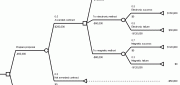
Advantages of Risk Analysis in Litigation
December 22, 2015
An indispensable tool for arriving at an informed settlement position Enhances counsel’s professional judgment “Gut...
December 22, 2015
An indispensable tool for arriving at an informed settlement position Enhances counsel’s professional judgment “Gut...
Uber Rewrites Driver Contract to Force Arbitration
December 21, 2015
Uber is taking a new approach in its fight to keep its drivers out of court and classified as independent contractors. The company appears undeterred by a federal court ruling earlier this week that rejected its arbitration agreement and expanded a class of drivers seeking employee status and benefits. On Friday, Uber Technologies Inc. released a new driver contract that purports to fix problems that U.S. District Judge Edward Chen of the Northern District of California said made arbitration requirements...
December 21, 2015
Uber is taking a new approach in its fight to keep its drivers out of court and classified as independent contractors. The company appears undeterred by a federal court ruling earlier this week that rejected its arbitration agreement and expanded a class of drivers seeking employee status and benefits. On Friday, Uber Technologies Inc. released a new driver contract that purports to fix problems that U.S. District Judge Edward Chen of the Northern District of California said made arbitration requirements...
Nussbaum on Mediation as Regulation
December 21, 2015
Lydia R. Nussbaum (University of Nevada, Las Vegas, William S. Boyd School of Law) has posted Mediation as Regulation: Expanding State Governance Over Private Disputes (Utah Law Review, 2016, Forthcoming) on SSRN. Here is the abstract: Across the United States, state legislatures are enacting statutory mediation mandates that govern how private parties resolve their disputes. Legislatures embed mediation mandates into specific statutory regimes ranging from foreclosure to healthcare to insurance...
December 21, 2015
Lydia R. Nussbaum (University of Nevada, Las Vegas, William S. Boyd School of Law) has posted Mediation as Regulation: Expanding State Governance Over Private Disputes (Utah Law Review, 2016, Forthcoming) on SSRN. Here is the abstract: Across the United States, state legislatures are enacting statutory mediation mandates that govern how private parties resolve their disputes. Legislatures embed mediation mandates into specific statutory regimes ranging from foreclosure to healthcare to insurance...
Artificial intelligence critic Elon Musk Launches $1B Non-Profit AI Research Company
December 20, 2015
Elon Musk, who has warned about the dangers of artificial intelligence, unveiled a non-profit AI research company Friday called OpenAI. OpenAI will be co-chaired by Musk and Y Combinator President Sam Altman, according to a blog post. "Since our research is free from financial obligations, we can better focus on a positive human impact," the post said. "We believe AI should be an extension of individual human wills and, in the spirit of liberty, as broadly and evenly distributed as is possible...
December 20, 2015
Elon Musk, who has warned about the dangers of artificial intelligence, unveiled a non-profit AI research company Friday called OpenAI. OpenAI will be co-chaired by Musk and Y Combinator President Sam Altman, according to a blog post. "Since our research is free from financial obligations, we can better focus on a positive human impact," the post said. "We believe AI should be an extension of individual human wills and, in the spirit of liberty, as broadly and evenly distributed as is possible...


